


Lot n° 74
Estimation :
2500 - 5000
EUR
Résultats sans frais
Résultat
: 2 500EUR
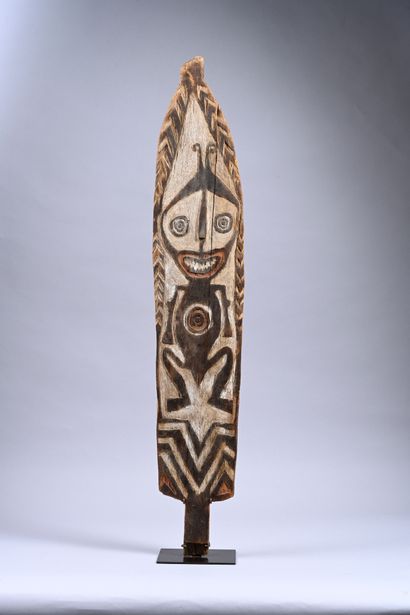
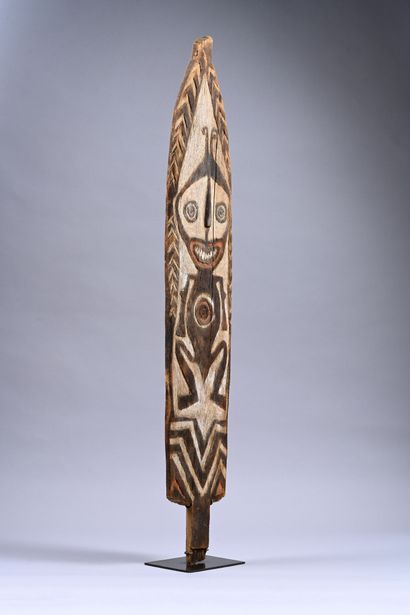
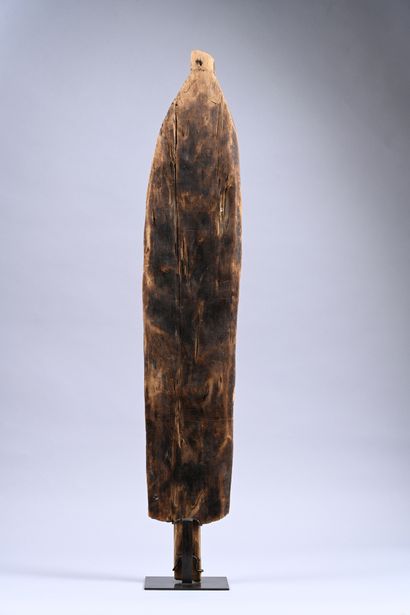
Planche Gope, Papouasie Nouvelle Guinée - Lot 74
Planche Gope, Papouasie Nouvelle Guinée
Bois, pigments naturels rouge, blancs, bruns
Hauteur 97 cm- Largeur 18,5 cm
Provenance :
Collection privée française
___
Gope Board , Papua New Guinea
Wood, natural pigments red, white, brown
Height 97 cm- Width 18.5 cm
Provenance :
French private collection
Au coeur des villages du Golfe Papou, au sud-est de la Papouasie-Nouvelle-Guinée, de grandes maisons communes, appelées, Maison des Hommes, étaient érigées. Chacune possédait un espace très particulier, contenant un sanctuaire dédié qui abritait des planches à esprit Gope, des figures Bioma, des crânes, et d'autres objets sacrés associés aux différents esprits, nommés imunu. A chaque imunu correspondait un élément, un lieu spécifique (terrain, cours d'eau ou océan), permettant de connaître, distinguer et géolocaliser le clan auquel il se référait.
La planche Gope, ou planche votive, également nommée planche des esprits, « spirit board », sculpture rituelle en deux dimensions, présente généralement des traits figuratifs desquels jaillissent des expressions souvent captivantes. La représentation schématisée de la figure humaine en Nouvelle-Guinée n'était pas destinée à matérialiser et désigner des hommes réels mais à incarner des figures d'esprits-ancêtres, des puissances surnaturelles.
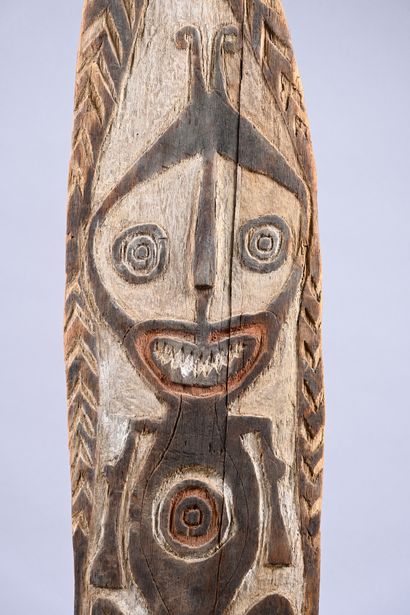
Inscrite sur un support en écorce rehaussé de pigments ocre-rouge sur sa surface, cette planche Gope aux caractéristiques du Golfe de Papouasie, se distingue par sa remarquable dynamique accentuée par l'ordonnancement rythmé des éléments du corps stylisés constitués de motifs en spirale ou ondulés rehaussés de pigments blancs et mis en relief par de délicats pourtours noirs. Sa puissance d'expressivité accentuée par la bouche très largement delaquelle jaillissent des dents limées blanches apparentes, l'intensité du regard accentuée par une répétition de formes cerclées. semble se mouvoir sur son support élancé. Comme les autres planches Gope, « elle était conservée dans l'alcôve du clan, dans la maison longue, et représentait l'ancêtre spécifique du clan » (Kaufmann in Peltier et Morin, 2006 : 424).
---
In the heart of the villages of the Gulf of Papua, in the south-east of Papua New Guinea, large common houses, called, House of Men, were erected. Each had a very special space, containing a dedicated sanctuary that housed boards with Gope spirit, Bioma figures, skulls, and other sacred objects associated with the different spirits, called imunu. To each imunu corresponded an element, a specific place (land, water or ocean), allowing to know, distinguish and geolocalize the clan to which it referred.
The Gope board, or votive board, also called 'spirit board', a two-dimensional ritual sculpture, usually has figurative features from which often captivating expressions spring. The schematic representation of the human figure in New Guinea was not intended to materialize and designate real men but to embody figures of ancestral spirits, supernatural powers.
Inscribed on a bark support enhanced with ochre-red pigments on its surface, this Gope board with the characteristics of the Gulf of Papua, is distinguished by its remarkable dynamic accentuated by the rhythmic sequencing of stylized body elements consisting of spiral or wavy patterns enhanced with white pigments and highlighted by delicate black edges. Its power of expressiveness accentuated by the mouth very widely delaquelle gush out of the teeth limed white apparent, the intensity of the look accentuated by a repetition of forms circled. seems to move on its slender support. Like the other Gope boards, “it was kept in the clan alcove, in the long house, and represented the specific ancestor of the clan” (Kaufmann in Peltier et Morin, 2006: 424).
Mes ordres d'achat
Informations sur la vente
Conditions de vente
Retourner au catalogue