


Lot n° 74
Estimation :
2500 - 5000
EUR
Result without fees
Result
: 2 500EUR
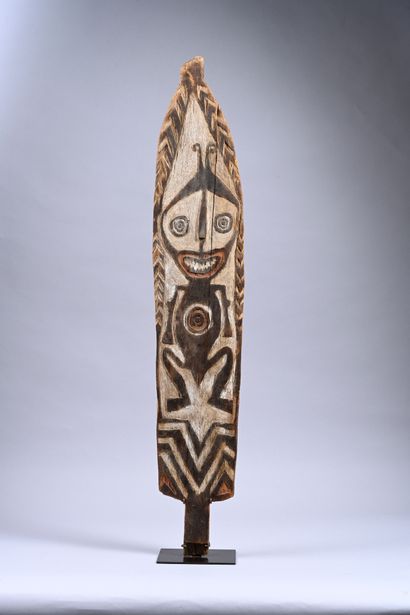
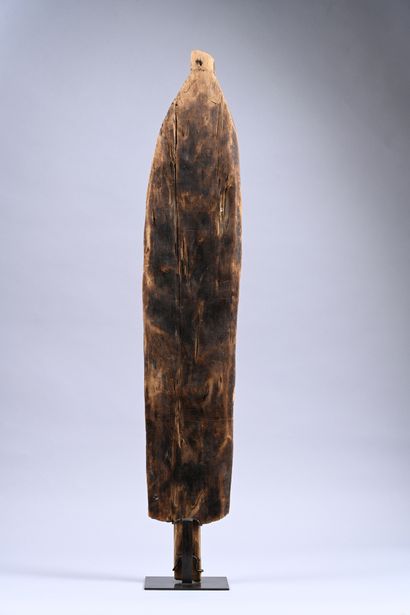
Gope board, Papua New Guinea - Lot 74
Gope board, Papua New Guinea
Wood, natural pigments red, white, brown
Height 97 cm- Width 18.5 cm
Provenance :
French private collection
___
Gope Board , Papua New Guinea
Wood, natural pigments red, white, brown
Height 97 cm- Width 18.5 cm
Provenance :
French private collection
In the heart of the villages of the Gulf of Papua, in southeastern Papua New Guinea, large communal houses known as Maison des Hommes were erected. Each had its own very special space, containing a dedicated shrine housing Gope spirit boards, Bioma figures, skulls and other sacred objects associated with different spirits, called imunu. Each imunu corresponded to an element, a specific place (land, river or ocean), making it possible to know, distinguish and geolocate the clan to which it referred.
The Gope or votive board, also known as the "spirit board", a two-dimensional ritual sculpture, generally features figurative features from which often captivating expressions emerge. The schematized representation of the human figure in New Guinea was not intended to materialize and designate real men, but to embody figures of spirit-ancestors, supernatural powers.
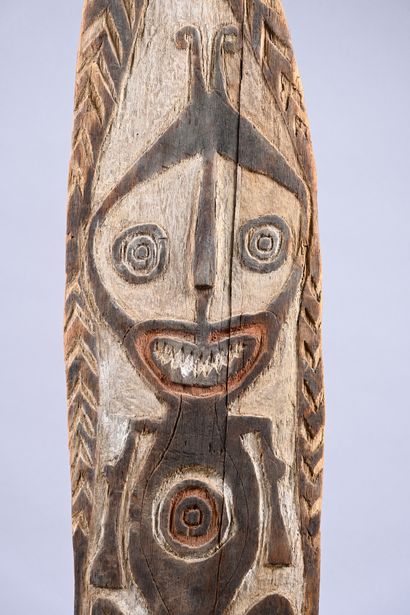
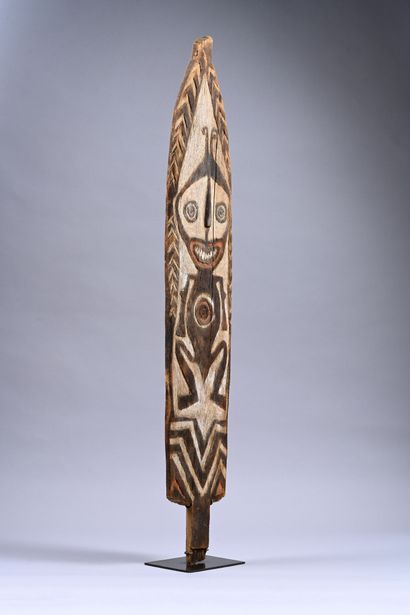
Inscribed on a bark support enhanced with ochre-red pigments on its surface, this Gope plate, characteristic of the Gulf of Papua, stands out for its remarkable dynamics, accentuated by the rhythmic ordering of the stylized body elements made up of spiral or undulating motifs enhanced with white pigments and highlighted by delicate black outlines. Its expressive power is accentuated by the wide mouth, from which white filed teeth protrude, and the intensity of the gaze, accentuated by a repetition of circled shapes. seems to move on its slender support. Like the other Gope plates, "it was kept in the clan alcove, in the longhouse, and represented the clan's specific ancestor" (Kaufmann in Peltier et Morin, 2006: 424).
---
In the heart of the villages of the Gulf of Papua, in the south-east of Papua New Guinea, large common houses, called, House of Men, were erected. Each had a very special space, containing a dedicated sanctuary that housed boards with Gope spirit, Bioma figures, skulls, and other sacred objects associated with the different spirits, called imunu. To each imunu corresponded an element, a specific place (land, water or ocean), allowing to know, distinguish and geolocalize the clan to which it referred.
The Gope board, or votive board, also called 'spirit board', a two-dimensional ritual sculpture, usually has figurative features from which often captivating expressions spring. The schematic representation of the human figure in New Guinea was not intended to materialize and designate real men but to embody figures of ancestral spirits, supernatural powers.
Inscribed on a bark support enhanced with ochre-red pigments on its surface, this Gope board with the characteristics of the Gulf of Papua, is distinguished by its remarkable dynamic accentuated by the rhythmic sequencing of stylized body elements consisting of spiral or wavy patterns enhanced with white pigments and highlighted by delicate black edges. Its power of expressiveness accentuated by the mouth very widely delaquelle gush out of the teeth limed white apparent, the intensity of the look accentuated by a repetition of circled forms. seems to move on its slender support. Like the other Gope boards, "it was kept in the clan alcove, in the long house, and represented the specific ancestor of the clan" (Kaufmann in Peltier et Morin, 2006: 424).
My orders
Sale information
Sales conditions
Return to catalogue