


Lot n° 66
Estimation :
100 - 200
EUR
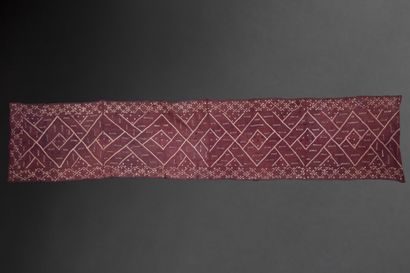
Grande parure tissée - Lot 66
Grande parure tissée
Aire Kassaï
République Démocratique du Congo
Première moitié du 20ème siècle
Tissus et pigments
Dimensions : 260 cm x 54 cm
« Le tissu est le lieu de friction de la mémoire des hommes, de leur imagination et de leur savoir, sinon d'une certaine science. Ainsi, interroger avec patience et rigueur la mémoire et l'espace vital des hommes peut éventuellement nous conduire, de lambeaux recousus en lambeaux recousus, à découvrir quelle part du corps et de l'esprit peut être lue dans ces objets de tissu. » (Prin, Reny, Michael Thomas, Christine Mainguy, and Sophie Pommier, Textile Art, Geneva: Skira, S.A., 1985.)
Les “panneaux textiles” Kuba, pour reprendre l’expression de Ardis M. Rewerts et Alira Ashvo-Munoz, se présentent sous la forme de rectangles de tissus en raphia ornés de motifs géométriques offrant un équilibre dynamique à la composition. Ces motifs textiles possèdent chacun un nom spécifique, variant d’un dessin à l’autre, mais respectant un cadre global laissant place à l’inventivité de l’artiste tout en maintenant un système de communication cohérent. Ces parures, tissées par les hommes et brodées par les femmes, constituaient les pagnes mapel ( masculins) et ntshak ( féminins)
Ce modèle présente un fond rouge brodé de motifs géométriques en entrelacs, évoquant une variante du motif bashungu, tel que reproduit par Emil Torday dans On the Trail of the Bushongo (1925).
----
“The fabric is the site where human memory, imagination, and knowledge—if not a certain science—intersect. Thus, patiently and rigorously exploring the memory and living space of people may eventually lead us, patch by patched patch, to discover which parts of the body and mind can be read in these textile objects.”
(Prin, Reny, Michael Thomas, Christine Mainguy, and Sophie Pommier, Textile Art, Geneva: Skira, S.A., 1985.)
The Kuba “textile panels,” to borrow the expression of Ardis M. Rewerts and Alira Ashvo-Munoz, take the form of rectangular raffia cloths adorned with geometric motifs that create a dynamic balance in the composition. Each textile pattern has its own specific name, varying from one design to another, yet respecting an overall framework that allows for the artist’s inventiveness while maintaining a coherent system of communication. These garments, woven by men and embroidered by women, comprised the mapel loincloths (male) and ntshak skirts (female).
This example features a red background embroidered with interlaced geometric motifs, evoking a variant of the bashungu pattern, as documented by Emil Torday in On the Trail of the Bushongo (1925). 200-300
Mes ordres d'achat
Informations sur la vente
Conditions de vente
Retourner au catalogue