


Lot n° 66
Estimation :
100 - 200
EUR
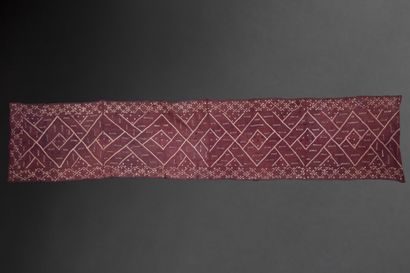
Large woven ornament - Lot 66
Large woven ornament
Kassaï area
Democratic Republic of Congo
First half of the 20th century
Fabrics and pigments
Dimensions: 260 cm x 54 cm
"Fabric is the friction point of human memory, imagination and knowledge, if not of a certain science. Thus, questioning with patience and rigor the memory and vital space of men can eventually lead us, from sewn-back shreds to sewn-back shreds, to discover what part of the body and mind can be read in these fabric objects." (Prin, Reny, Michael Thomas, Christine Mainguy, and Sophie Pommier, Textile Art, Geneva: Skira, S.A., 1985.)
The Kuba "textile panels", as Ardis M. Rewerts and Alira Ashvo-Munoz call them, take the form of rectangles of raffia fabric, decorated with geometric patterns that lend dynamic balance to the composition. These textile motifs each have a specific name, varying from one design to the next, but respecting an overall framework that leaves room for the artist's inventiveness while maintaining a coherent system of communication. These ornaments, woven by men and embroidered by women, made up the mapel (male) and ntshak (female) loincloths.
This model features a red background embroidered with interlacing geometric motifs, evoking a variant of the bashungu pattern, as reproduced by Emil Torday in On the Trail of the Bushongo (1925).
----
"The fabric is the site where human memory, imagination, and knowledge-if not a certain science-intersect. Thus, patiently and rigorously exploring the memory and living space of people may eventually lead us, patch by patched patch, to discover which parts of the body and mind can be read in these textile objects."
(Prin, Reny, Michael Thomas, Christine Mainguy, and Sophie Pommier, Textile Art, Geneva: Skira, S.A., 1985.)
The Kuba "textile panels," to borrow the expression of Ardis M. Rewerts and Alira Ashvo-Munoz, take the form of rectangular raffia cloths adorned with geometric motifs that create a dynamic balance in the composition. Each textile pattern has its own specific name, varying from one design to another, yet respecting an overall framework that allows for the artist's inventiveness while maintaining a coherent system of communication. These garments, woven by men and embroidered by women, comprised the mapel loincloths (male) and ntshak skirts (female).
This example features a red background embroidered with interlaced geometric motifs, evoking a variant of the bashungu pattern, as documented by Emil Torday in On the Trail of the Bushongo (1925). 200-300
My orders
Sale information
Sales conditions
Return to catalogue