


Lot n° 375
Estimation :
6000 - 8000
EUR
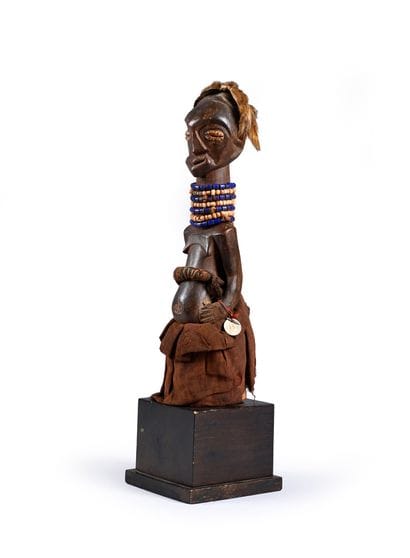
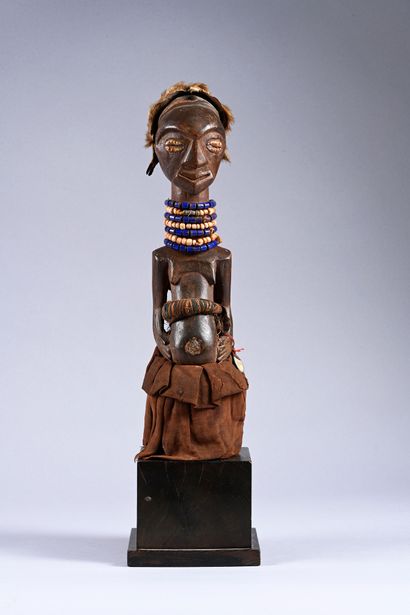
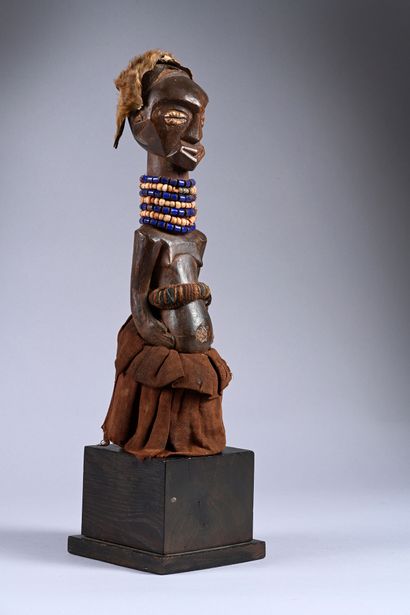
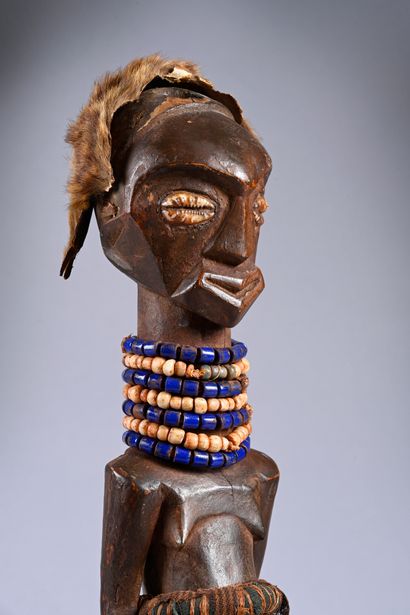
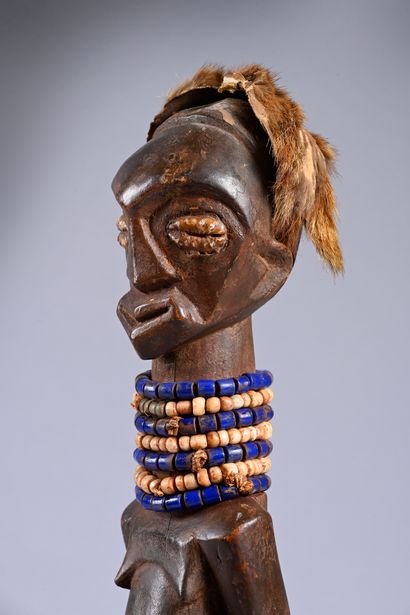
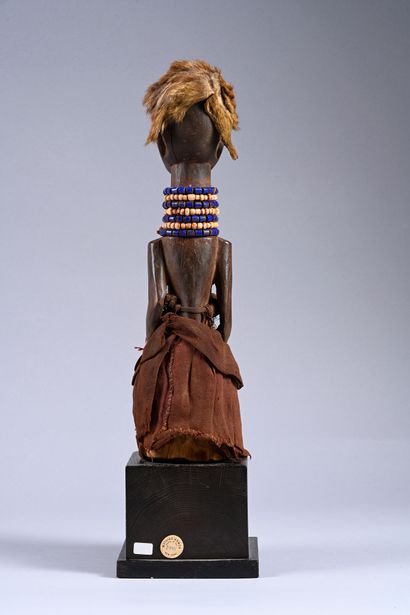
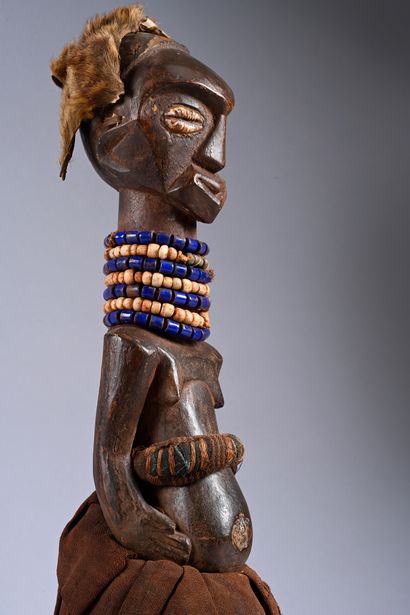
Nkishi power figure, Songye Democratic Republic of Congo - Lot 375
Nkishi power figure, Songye Democratic Republic of Congo
Early 20th century
Carved wood, cowrie shells, leather and pearls, fabric, skin
H. 33 cm
Provenances :
Leo Meurrens Collection, Leuven (1905-1966)
Pierre Dartevelle Collection, Brussels
Private collection, New York
Note: See François Neyt (L'univers Songye) for the symbolism of ornamentation, and the classification of stylistic belonging according to physiognomy.
Inhabited by an unequalled strength, power and breath, Songye statuary is as fascinating in its form as it is fearsome in its beauty, associated with magico-religious beliefs. When it first came into contact with Europeans, it aroused mistrust, fear and admiration. As early as the 19th century, artists such as Paul Gauguin and Georges Braque began to appreciate its extraordinary creativity and formal power.
They live on a vast territory between Sankuru in the west and Lualaba in the east. The largest concentration of Songye is found in the present-day province of Kasai Oriental, also occupying parts of the provinces of Katanga and Kivu. The Songye are not a homogeneous socio-cultural entity, subdividing into several linguistic and cultural groups, they are essentially organized around chiefdoms.
Believing in the links between the world of humans and that of spirits, through the mystical power of the chiefdom (Daniel Bieduyck, 1992, p.27), and driven by magico-religious ideals, they fashion statuary that is both an effigy of power with the attributes of kings, and an intermediary between these two poles.
Religious in nature and carrying political references, this statuary with its supernatural connotations, through its form and ornamentation, enabled humans to maintain a link with the spiritual world.
Small in size, Songye statues were intended to serve particular interests, manipulated solely by the sorcerer in a private setting, and were linked to procreation, protection against disease and witchcraft. According to Hersak (1986), they differ from other Songye magical objects in that they are instruments for interacting with higher spirits associated with ancestors.
Songye myths tell us that the nganga - a ritual specialist with protective and therapeutic powers - was designed by the god Efile to help men fight evil spirits. It is he who makes the magical components known as bishimba, incorporated here in the horn, in the bust and accumulated on the abdomen. The value of the nkisi depends on the effectiveness of these medicines.
Their real power derives from the bishima, concealed substances composed of ingredients "that provide the aggressive content capable of neutralizing the source of malevolent action." (Hersak, 1995, pp. 345-347). This remarkable example, which belonged to Pierre Dartevelle, exalts the strength contained in its expressiveness, vibrating with a resounding force of presence conferred by its strangeness, characteristic of Songye statuary, by the brilliance of its deep brown patina, and by its ornamental elements concealing powers, testifying to its ability to divert malevolent spirits.
Invariably manipulated by an experienced sorcerer, it is richly adorned with attributes characteristic of chiefs, warriors or hunters, three social ranks particularly respected as essential to the survival of the community.
"Learn that every symbol has a meaning, two meanings or even several. These meanings can be diurnal or nocturnal. The diurnal are good, the nocturnal are bad. Amadou-Hampaté Ba.
As Nyet indicates, reveals and explains, each symbol, each feature, each gesture is not a coincidence, or a formal liberty born of the sculptor's imagination; each shape, each detail carries a strong symbolic meaning. The gestures of communication, the look in the eyes and the words convey a magical symbolism.
His angular face, with its prominent features and lines, and a blunt nose set in a triangle, is marked by a prognathic jaw in relief. The rigor of its strict lines is contrasted with the softness of the curves delineating the superciliary arches and the raised forehead, the whole accentuating the range of the gaze signified by two large cowries. "The cowrie shell-shaped eye is an explicit allusion to the Kalebwe fodder myth and their stay near Lake Moero, and is clearly linked to power and magic; this shell, drawn from the water, links it to the genies of the night." (François Nyet, Songye, Editions 5 continents, p.290) According to François Nyet's analysis, cowrie shell eyes account for only 11% of Songye statuary.
"Half-closed eyes r
My orders
Sale information
Sales conditions
Return to catalogue