


Lot n° 371
Estimation :
5000 - 8000
EUR
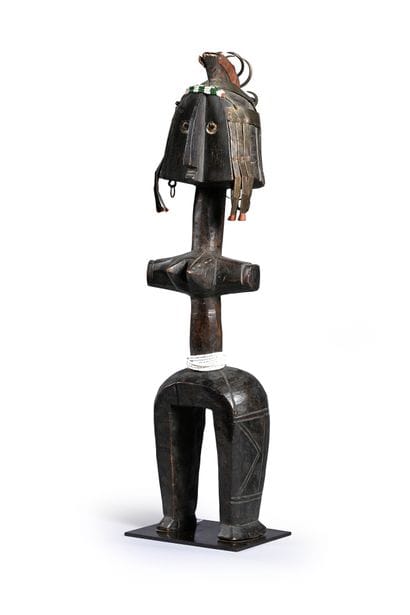
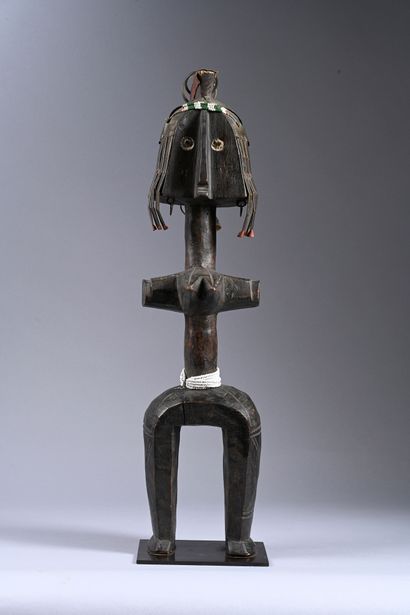
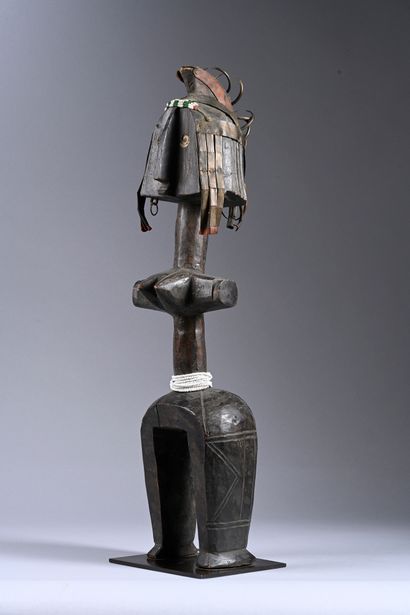
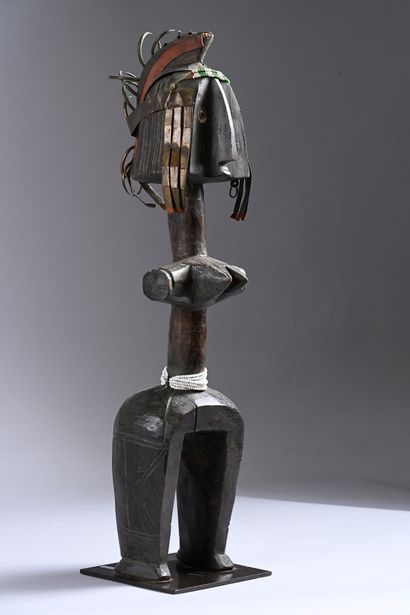
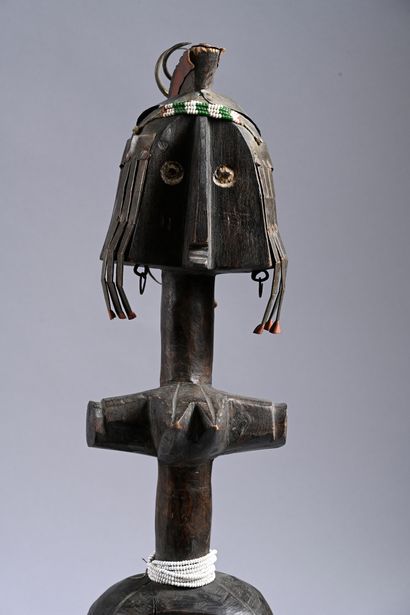
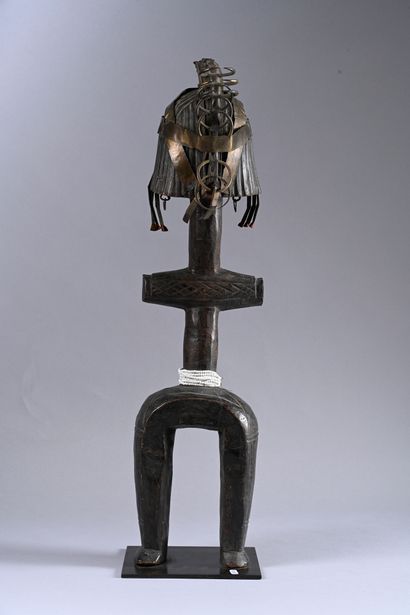
Bagirmi statue Mali - Lot 371
Bagirmi statue Mali
Wood, metal, beads
Dimensions: H.: 57.5 cm - W.: 13 cm
Provenance :
French private collection
A rare example of this type for a work probably by the same hand, lot 192, Christie's Paris, sale December 10, 2003, once owned by Pierre Harter.
Description:
At the heart of the vast Sahelian region to the east of Chad, the kingdom of Baguirmi emerged in the second half of the 15th century as an Islamic state, founded by Arab and Berber populations from the north, who imposed themselves on local societies. This kingdom, which remained under French tutelage until the early 20th century, nevertheless retained a traditional political structure and a particularly fertile cultural syncretism. The art of Baguirmi, although poorly documented and for a long time on the bangs of the great corpus of sub-Saharan Africa, bears witness to a remarkable formal and ritual vitality. Only a handful of figurines have survived, revealing a rare plastic language deeply rooted in a complex symbolic system.
These "timeless idols", as Bernard de Grunne calls them, embody a silent, archaic force: their enigmatic presence, formal autonomy and intense spiritual charge go beyond ritual functions, establishing them as universal manifestations of the sacred. They are distinguished by an immediately recognizable sculptural style, combining hieratic and schematized forms. This is the context for this work, remarkable for its profound singularity within the corpus.
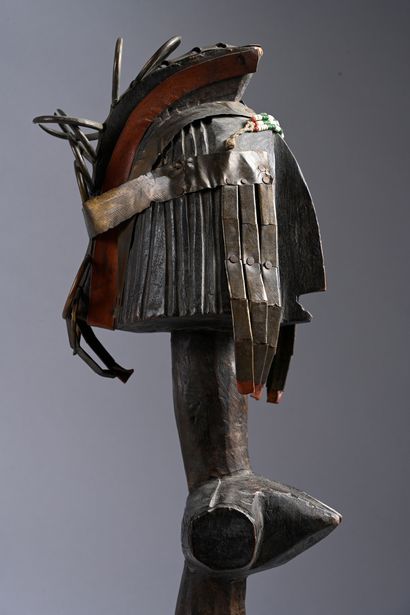
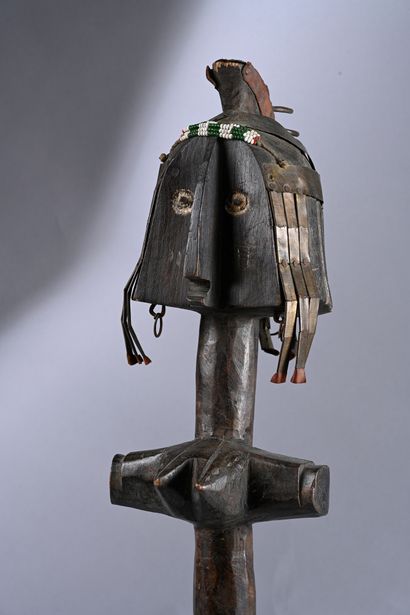
This rare example is comparable to a work, probably by the same hand as lot 192 of Christie's Paris sale of December 10, 2003, from the Pierre Harter collection. The distinguishing feature of these two pieces is the headdress, composed of fine metal strips, the arrangement of which creates a subtle play of reflections and textures. This structure evokes the traditional hairstyles of Baguirmian women, composed of several thick braids of ewe's hair or blackened plant fibers, carefully added to the hair. The ornamental concern is accentuated by the addition of body adornments - headband and beaded hip collar. The face, structured by a long, rectilinear nose, is enlivened by two round eyes with marked pupils, while a small, pinched mouth accentuates its silent expressiveness. The treatment of the body combines plastic strength and naturalistic tension, inscribing the figure in space with controlled audacity.
The rigorous verticality of the neck and torso is matched by the orthogonal momentum of the atrophied arms, sculpted at a right angle, and the tension of the conical breasts projected forward, while the lower body widens with confidence, giving the figure a solid foundation, perched on short, spread legs. According to Bernard de Grunne, the substitution of a pair of legs for the usually cylindrical torso reflects a stylistic variant marking a later evolution of the traditional canon. Femininity, subtle yet assertive, is expressed as much by these attributes as by the supple lines, which seem to evoke ritual gestures. According to ancient observations, these idols could be activated in dance, with women placing them on their heads in a rhythmic movement of the pelvis - as if the sculpture, through its restrained grace, reactivated the memory of a dancing body.
My orders
Sale information
Sales conditions
Return to catalogue