


Lot n° 370
Estimation :
6000 - 8000
EUR
Result with fees
Result
: 7 800EUR
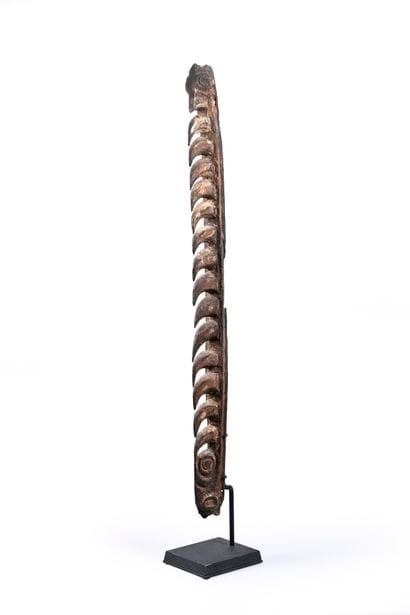
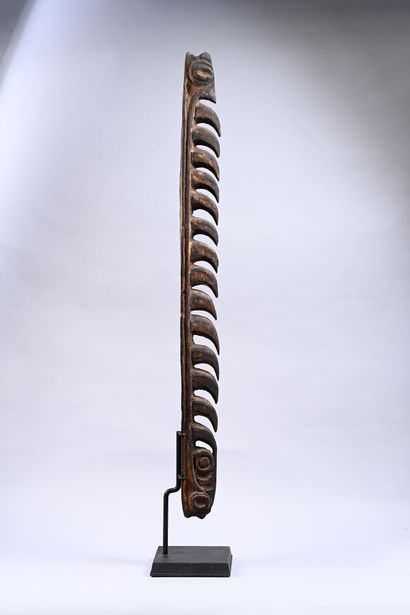
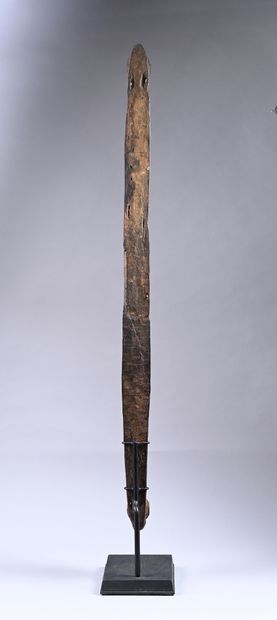
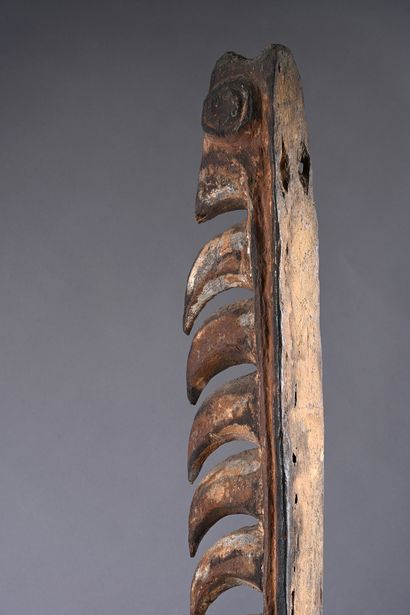
Ritual figure placed in the roof structure of the ceremonial - Lot 370
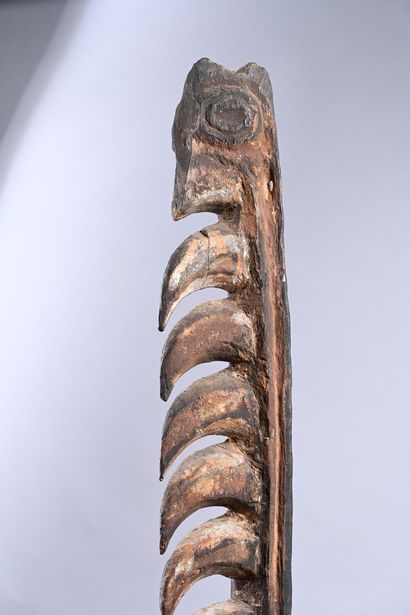
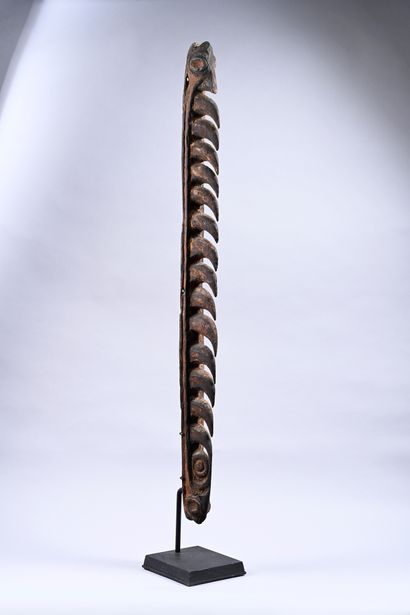
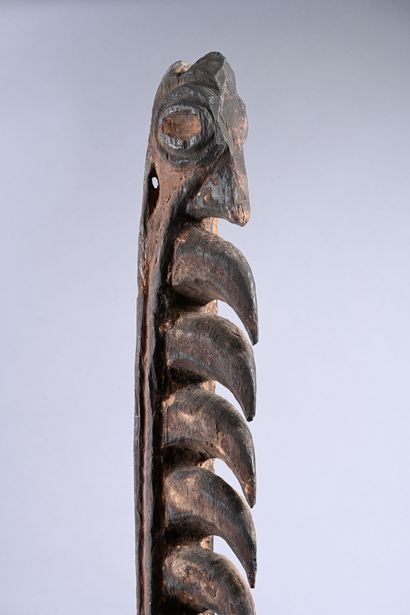
Ritual figure placed in the roof structure of the ceremonial house, Nggala population, Upper Sepik, Papua New Guinea
Early 20th century
Carved wood and pigments
H. 119 cm
Provenance :
Collected by Wayne Heathcote circa 1974
Douglas Newton Collection (1920-2001), New York
Collection Marcia & John Friede (Jolika), New York
Lempertz, Brussels, Sept 2021 lot 179
Literature :
Douglas Newton, Crocodile and Cassowary, New York, 1971, p. 42, fig. 68.
Along with boats, houses are the most important material achievements of Oceanian populations. In the Sépik valley, men still use traditional methods to build vast edifices which, through the materials used, are an emanation of ancestral spirits.
The Iatmul, who are particularly well known as great architects and builders of prestigious edifices on the banks of the river, construct imposing ceremonial houses once reserved only for initiated men, averaging 25 metres long by 8 metres wide (Nguyen van Huyen, 1934: 75-78, Guerreiro, 1997: 1131-1134, in Revue d'ethnobiologie, 2000-20004, vol. 42: 147-164, Christian Coiffier and Catherine Orliac)
Their imposing size, their limited and reserved access, is matched by the power of their symbolism, and the importance of their centralizing role in the community; functioning like a small parliament, every group in society was represented.
Symbolically and analogously, the frame of the house resembles a human or animal skeleton, ideally representing the whole community perceived as a female body or a female crocodile. The frame of the house rests on these pillars, which represent the bones of the maternal ancestors of the various clans making up the community. The large lateral pillars (katkat kwala) supporting the roof are considered male, while the smaller ones (lulungue kwala) supporting the interior platform are considered female and the sisters of the former.
Matter matters and means just as much as form indeed; "According to the Iatmul worldview, humans are the descendants of trees and animals, for there are no formal boundaries between what we call the mineral, animal and vegetable kingdoms. These two varieties of woody plants are thus respectively considered the ancestors of the iatmul clans. In their genealogies, miamba's mother is called Kandjindawa. She is the younger sister of Ndemanagwi, the mother of the kwarap tree (Intsia bijuga), the secondary timber used for prestigious constructions." p156
Organized according to pre-established codes, the interior of the ceremonial house concentrated symbols and objects. In the loft, the most precious objects belonging to each clan were concealed: long bamboo flutes, rhombes, wickerwork masks, various drums, torches and war spears.
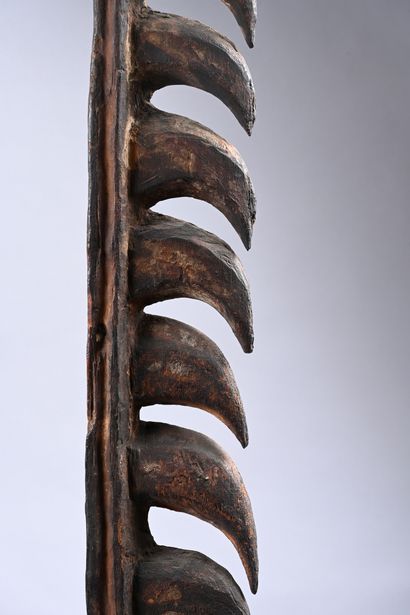
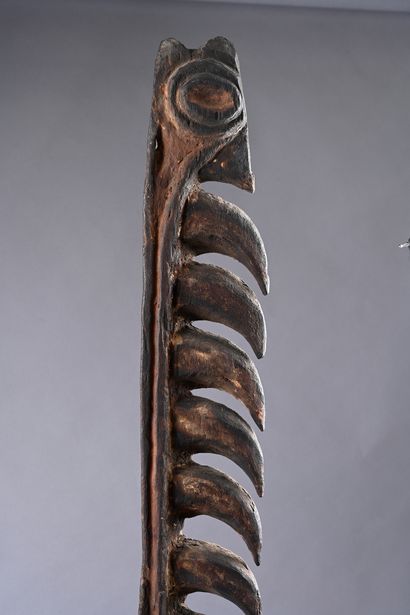
This work, collected by Douglas Newton, has a distinct, particular, elevated and central character in relation to the other objects preciously preserved within the house. At the heart of the ceremonial house, this hook was, as indicated in his notes (Crocodile and Cassowary (p. 34), fixed to the inside of the roof peak. Representing manyura, a thorny vine used for witchcraft and healing, it was favored by the Nggala.
As rare as this population of around 140 people, cannibals and headhunters, living in a single village at the junction of a waterway that runs between the Sepik itself and a point a few kilometers upstream from the April River, and another that, running directly east and west, connects to the western end of a waterway through the Hunstein Mountains. As well as being the name of the people, Nggala is also the name of the village itself.
To its rarity, its healing power, its place within the levitating, elevating structure, responds its singular beauty, stretched out vertically, the dynamics of the hook rendered by the succession of arched forms plunging towards the ground, probably metaphorically representing the thorns of the virtuous lantern represented. With its refined poetry and elegant sobriety, this work is appreciated as much for its rarity as for its power to heal, and therefore its symbolism of protection.
My orders
Sale information
Sales conditions
Return to catalogue