


Lot n° 364
Estimation :
600 - 800
EUR
Result with fees
Result
: 780EUR
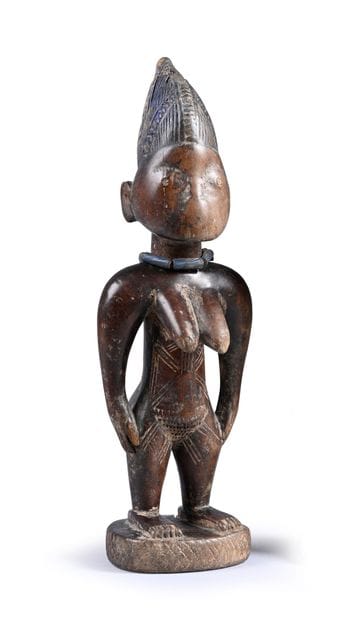
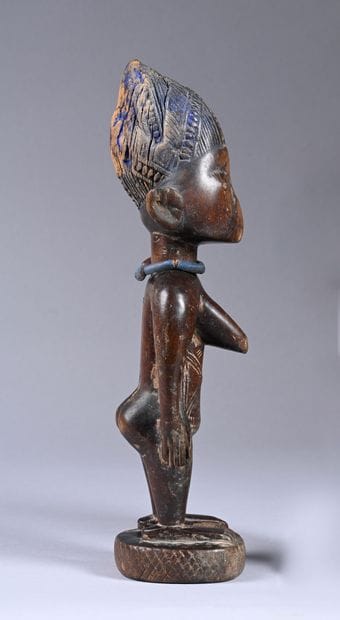
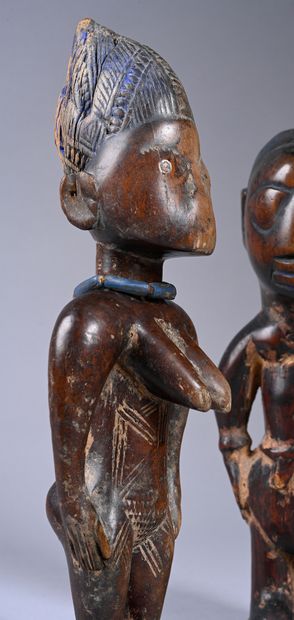
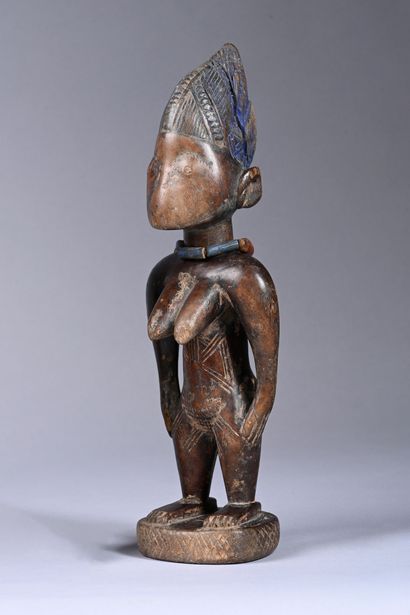
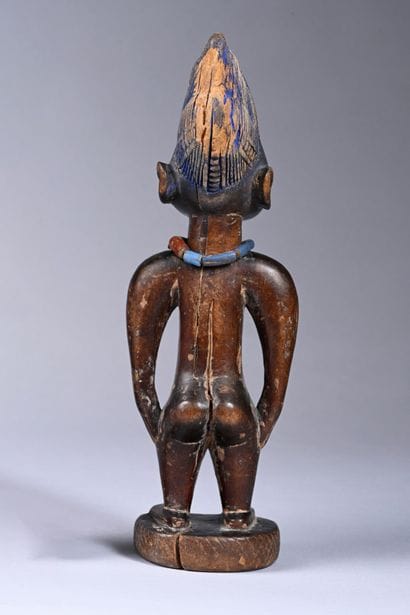
Female statuette, Ibeji era, Yoruba (Oyo) Nigeria - Lot 364
Female statuette, Ibeji era, Yoruba (Oyo) Nigeria
Wood, smooth patina, pigments, beads
H. 27.5 cm
Provenance :
Former Veena and Peter Schnell Fagg Collection
French private collection
Description:
These effigies, known as ere ibeji, are not simply commemorative objects. Nourished, washed, adorned with pearls, ointments and clothes, they are an integral part of the family unit. Alive, they receive daily, ritualized attention, charged with affection and hope.
These effigies reveal a conception of the world in which the object is never inert: it becomes the carrier of a soul, a relay of vital energy, a silent witness to the love borne to a missing child. In this respect, ere ibeji are inhabited works, imbued with a dignity and inner power that transcend their modest format. They don't commemorate an absence - they celebrate continuity.
This female ibeji is in the characteristic style of the Yoruba people who settled in the Òyó region, particularly around the town of Saki, a hotbed of traditional sculpture in the ancient kingdom - characterized by generously modeled volumes, rounded shoulders and arms detached from the body, giving the figure a dense, masterful sculptural presence. The effigy is distinguished by the network of scarification marks on the abdomen, lower abdomen and thighs, the complexity of the braided hairstyle enhanced by indigo blue, all magnified by the smooth, shiny patina. Blurred by time and ritual gestures, the somatic features preserve the moving trace of the care lavished on the twin's spirit, revealing the depth of the bond that united this effigy to its family.
Among the Yoruba, it is through the head, orí, that the link with the spiritual world is established; it is the privileged receptacle, and this explains the particular devotion attributed to the face in many of these effigies, like our object. This gradual erasure of matter - initiated by the mother, then continued after her disappearance by other women in the family - gives these effigies a moving, ever-changing character. It is in this sense that Émilien Bruneau rightly describes them as "evolving works", so much so that their form carries the sensitive memory of the gestures and ties that have shaped them over time. ("L'ere ibeji et le culte des jumeaux chez les Yoruba", In: Histoire de l'art, N°73, 2013. Sacred objects. p.151).
My orders
Sale information
Sales conditions
Return to catalogue