


Lot n° 362
Estimation :
8000 - 12000
EUR
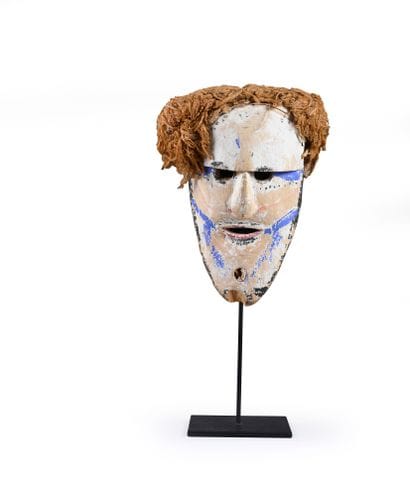
Lor mask, Duke of York Islands, Northern Gazelle Peninsula - Lot 362
Lor mask, Duke of York Islands, Northern Gazelle Peninsula
Bismarck Archipelago, Papua New Guinea
Early 20th century
Carved wood, pigments, plant fibers
H. 31.5 cm
Provenance :
Private collection, Adelaide, Australia
Collection Joost & Truus Daalder, Australia, acquired in the 1990s
"All art is the expression of a civilization. Our art reflects European civilization. In the same way, the Oceanians have created art that reflects their way of thinking and living." (Michel Rauzier "L'affiche ethnographique", Gradhiva, winter 1989-1990, n°7, p.92.)
Richard Parkinson was the first to give a detailed description of these masks. According to him, the Tolai had two types of Lor masks. Wooden masks and over-modelled skulls. He adds that they were used for ceremonial exchanges and, in the past, for named public performances in which the mask bearers would slowly and silently circle the dancers. They appeared at dances linked to funeral ceremonies called tambaran kakao, during which they represented the spirit who had initiated the foundations. (Anthony Meyer (Paris)).
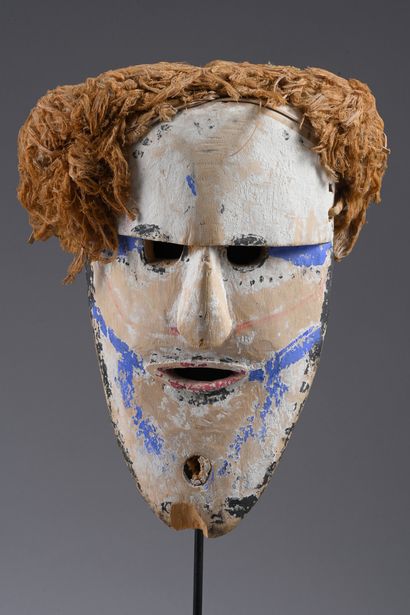
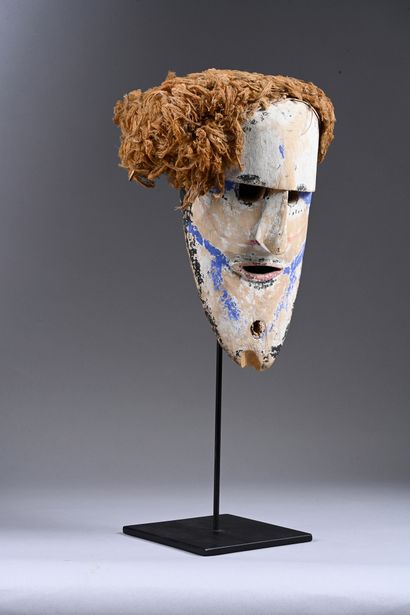
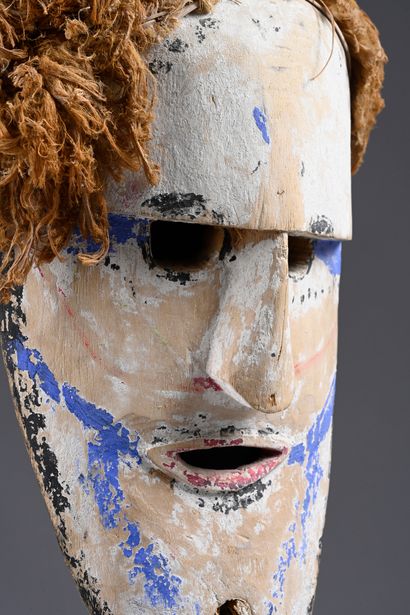
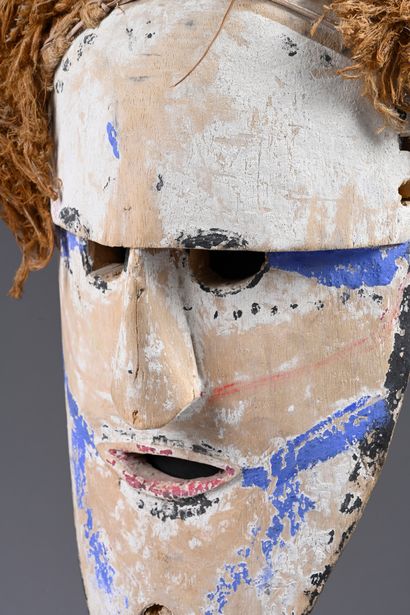
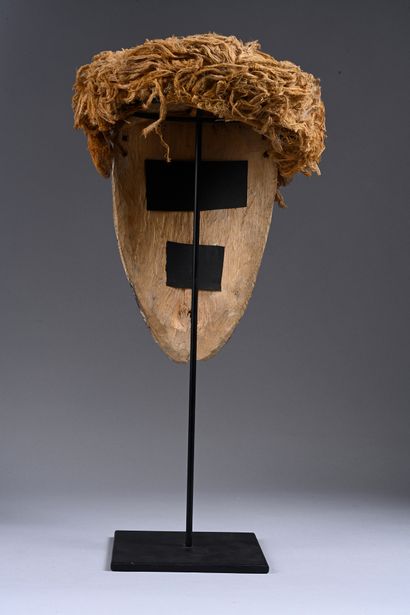
Carved from light wood, the face's minimalist features exude a powerful austerity, an almost ferocity, conferred by the play of planes between the raised, slightly domed forehead, clearly and strictly delineating a linear, horizontal arch of the eyebrows, and the flattened, recessed lower part of the face. The wide-set, circular eyes intensify the scope of the frozen gaze. The thick, triangular nose juts out in relief. The mouth, with its thin lips, is half-open.
The entire surface, as is traditionally the case in the limited corpus, is covered in white pigments, symbolizing, for the Tolai, death and the spirit world. Residual black pigments are associated with initiation and spiritual transformation, and reds with fertility and life (in. Papua New Guinea, Papuans in Paris. Melpa, Mudmen, Chambri, Trobriands, musiques et danses, June 20 1990, P.20-22).
Rarer blue pigments, generally resulting from the use of imported brightening agents, reveal a meaning still unknown today.
Its rich headdress, woven from plant fibers, has been preserved.
My orders
Sale information
Sales conditions
Return to catalogue