


Lot n° 360
Estimation :
10000 - 15000
EUR
Result with fees
Result
: 13 000EUR
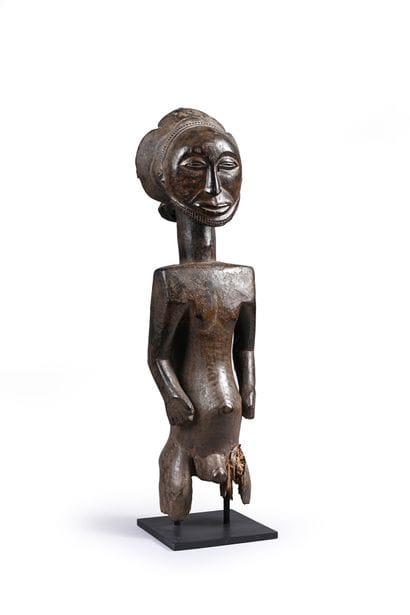
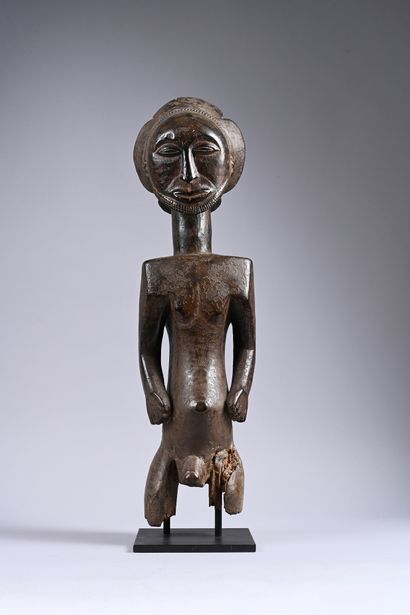
Hemba statue Democratic Republic of Congo - Lot 360
Hemba statue Democratic Republic of Congo
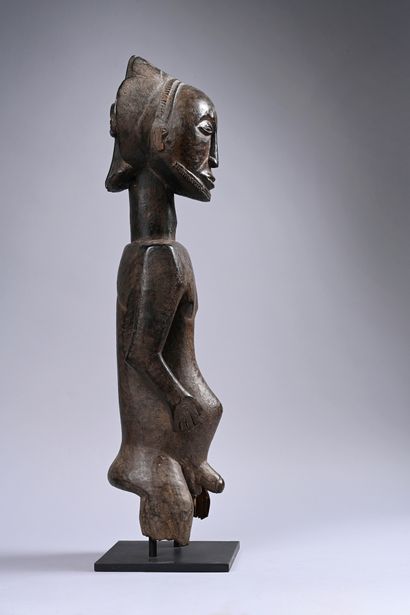
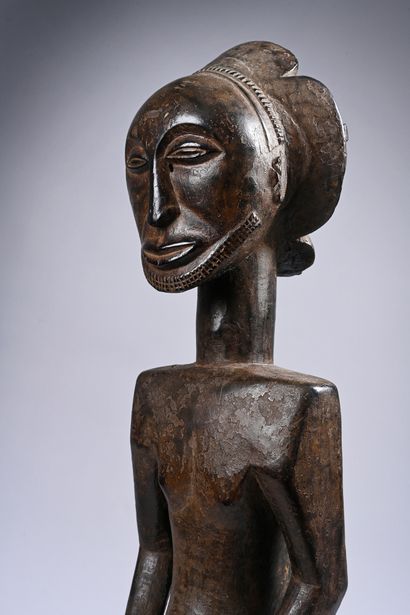
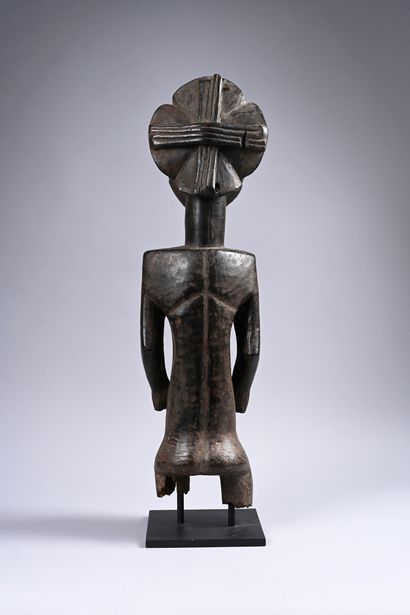
Glossy patina, typical missing parts on the hips, thick crusty patina in places.
Dimensions: H.: 66 cm - W.: 17 cm
Provenance :
French private collection
Appraised and acquired from Madame de Monbrison handwritten certificate and stamp "Simone de Monbrison, ARTS ANTIQUES ET PRMITIFS, 11 rue des Saints-Pères, Paris VI°".
Living in the south-east of the Democratic Republic of Congo, on land between the Congo River (to the west) and Lake Tanganyka (to the east), the Hemba essentially celebrated and honored their high-ranking male ancestors, invoking their spirits to protect their society.
Sacred effigies, eminent mediators between prestigious ancestors and the living members of the community, these statues embodied the junction between the community's past and future. They recounted the history of the clan and its lineage, while attesting and legitimizing power and possession of the land.
Known and named among the Hemba as singiti (or lusingiti in the singular), they were preciously preserved in sanctuaries dedicated to them (LaGamma, Heroic Ancestors, 2012, pp.225-270). The height of their value, the greatness of the virtues with which they were imbued, was matched by the particular process of their creation. Singiti were carved uniquely by the ngoongo from a wood specifically dedicated to them, called muvula (chlorophora excelsa), a species planted in front of the clan chief's hearth and which played the role of "plant altar" for ancestral cults.
Sacred possessions of each Hemba lineage chief, they played a part in the memory and genealogical construction of the clan by incarnating a particular ancestor. In their presence, a ritual linked to ancestor worship was supervised by the chiefs, and the benevolence of the spirits of the ancestors over the entire community of the living depended on its progress, rigorous scheduling and quality of execution.
Their imposing presence and elegant, powerful stature reflected the power with which they were entrusted, and the importance of the spirit known as misi, which was invested in them.
Their strong stature and muscular volumes intensify their presence and dignity. The elegance and subtlety of its fine details magnify its power and high-ranking statue. Its black, brown lacquered patina, with its slightly crusty surfaces, bears witness to the invocation rituals it was honored with in the past.
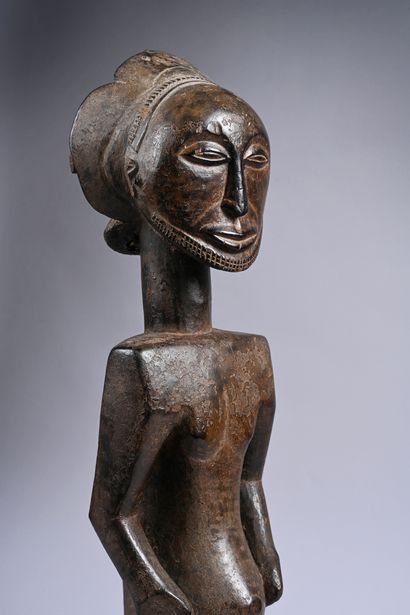
The face is of idealized naturalism, with fine, harmonious features and a perfectly smooth, rounded forehead. The superciliary arches overhanging the half-closed eyes accentuate the beauty of their stretched almond shape, with delicately hemmed eyelids.
The beautiful, shiny, dark patina on the fine bridge of the triangular nose, subtly linked to the arched eyebrows, remarkably reinforces the finesse of its prominent features. The benevolent softness of her smile is accentuated by the dark patina of her lips, giving the effigy a striking humanism. The subtlety of her features, in particular her pronounced nasolabial folds, enliven the figure with surprising realism.
The headdress is announced by a raised frontal tiara encircling the head, magnifying the rounded shape of the face. A wealth of detailed ornamentation, prestigious insignia remarkably symbolizing the high rank of the embodied figure. The tiara features a series of engraved square motifs at the top, while a beard collar in slight relief, consisting of two rows of small squares in relief, runs around the lower jaw.
The ample hairstyle, in a broad shell stretched backwards, consists of a sophisticated circular bun. Crossed by two knotted braids forming a central knot, it corresponds, according to François Neyt's study, to a "6 E" type headdress. The massive, cylindrical neck features a slight protrusion in relief, suggesting Adam's apple and affirming masculinity, revealing the realism sought, animating the ancestor sculpture with a powerful veracity of existence.
The successive juxtaposed curves and counter-curves between the hollow of the thorax and the generous, bulging abdomen, a stylistic characteristic typical of Hemba statuary, remarkably intensify its posture and dynamic vitality. A slight asymmetry in the shoulders suggests movement, giving the work an almost living character.
The arms, slightly bent away from the body, with hands placed delicately on the lower abdomen, draw the eye to this strong symbolic gesture, to the umbilicus in r
My orders
Sale information
Sales conditions
Return to catalogue