


Lot n° 234
Estimation :
600 - 800
EUR
Register for the sale on drouot.com
Leave absentee bid
Your amount
EUR
Bid by phone
Bid by phone
Your amount
EUR
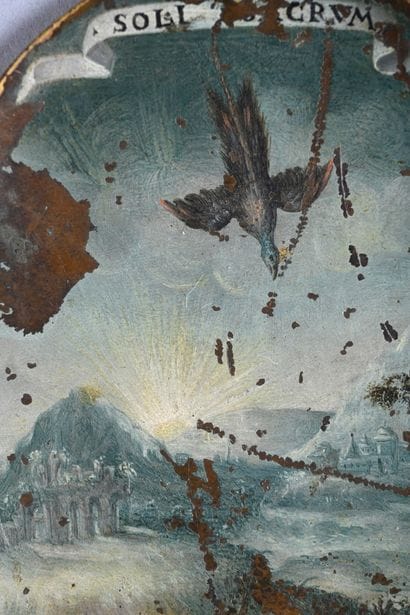
Two domed oval medallions made of engraved brass, with paint - Lot 234
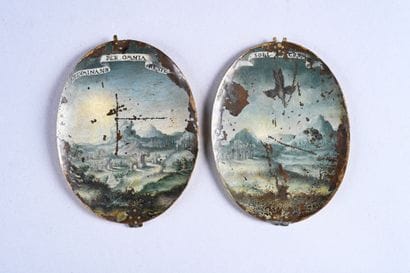
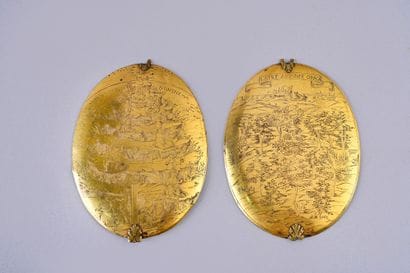
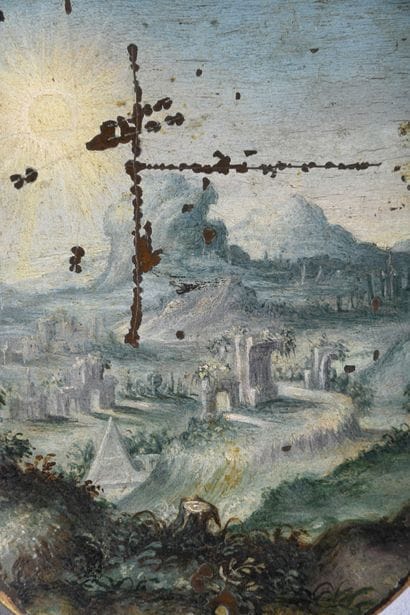
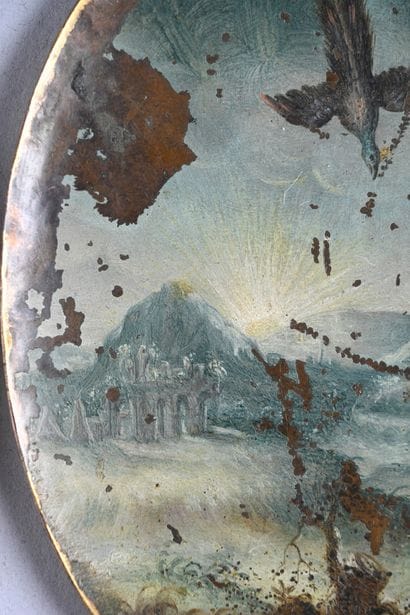
Two domed oval medallions made of engraved brass, with painted interiors, formerly joined by hinges. The outer surface of the first is adorned with a composition symbolizing the Liberal Arts. At the foot of a mountain, a seated man writes in a book, while a woman accompanied by two young children passes through the “Gate of Wisdom.” On the other side, Priscian or Donatus, crowned by Grammar, awaits them, Cicero and Rhetoric, Aristotle and Logic, Tubalcain and Music playing the organ, Ptolemy and Astronomy holding a globe, Euclid and Geometry, Pythagoras and Mathematics. At the top sits a bishop flanked by a Franciscan friar; above them, a woman holding a triangle, and God the Father appears in the cloud. The upper border bears the inscription “NON CVIVIS HOMINI.” The design on the inner side depicts a landscape dotted with ruins, including a pyramid, and the painted inscription “ILLVMINANS PER OMNIA RESPE[XIT].” The inner side of the second medallion features a similar design, surmounted by a diving bird. It bears the inscription “SOLI SACRVM.” The outer surface, engraved with a dense forest and fortified cities, bears the words “LATET ARBORE OPACA.”
Southern Netherlands, mid-18th century
H.: 12.8 cm - W.: 9.9 cm
The composition adorning the first medallion is inspired by an allegory of the Liberal Arts attributed to Biagio d’Antonio Tucci (1446–1516) and housed at the Musée Condé in Chantilly (fig.). The inscription above it alludes to the quest for knowledge, which, in Horace’s words, “is not given to every man” to attain: “Non cuivis homini contingit adire Corinthum” (Epistles, I, 17, 36). The inscription on the other side, meanwhile, quotes a passage from Virgil: “Latet arbore opaca aureus et foliis et lento vimine ramus,” the Sibyl’s reply revealing that only a golden bough, “hidden in an impenetrable tree,” opens the gates of the Underworld” (Aeneid, 6, 135). The inscriptions painted on the reverse side of each medallion, meanwhile, allude to the sun; they are found in particular on sundials, which borrow them from Ecclesiastes (42:16).
My orders
Sale information
Sales conditions
Return to catalogue