


Lot n° 35
Estimation :
6000 - 8000
EUR
Register for the sale on drouot.com
Leave absentee bid
Your amount
EUR
Bid by phone
Bid by phone
Your amount
EUR
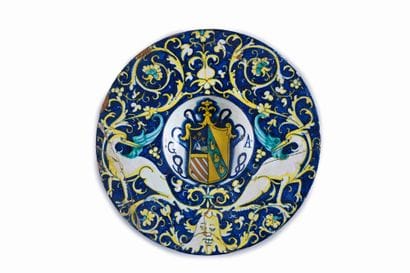
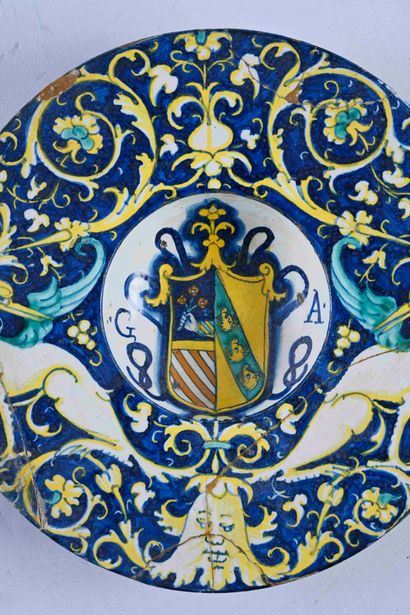
Deruta Tondino majolica with polychrome decoration featuring - Lot 35
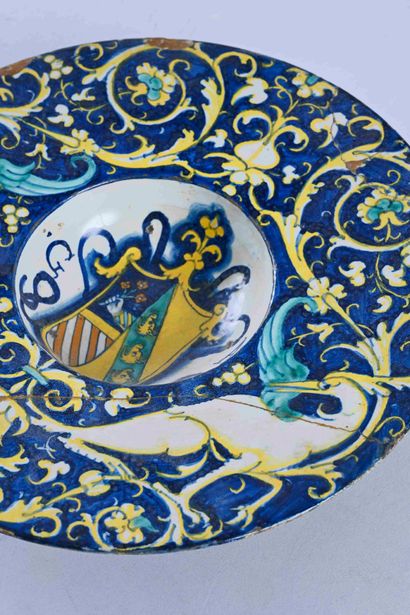
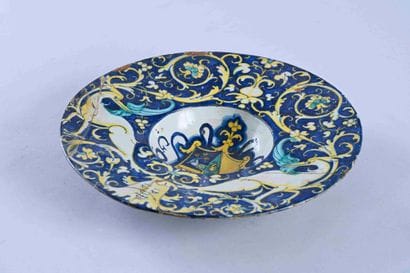
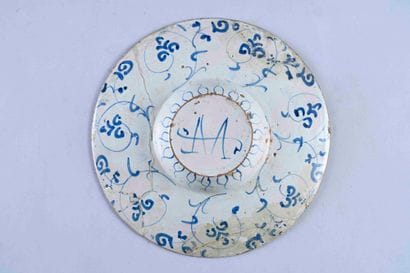
Deruta Tondino majolica with polychrome decoration featuring a combined coat of arms in the center—one of the two families being the Fiorucci di Pietralunga—within a shield framed by the letters G and A and resting on the wings of two griffins, a mascaron and foliage scrolls on a blue background. Probably from the workshop of Giacomo Mancini, known as “Il Frate,” or his uncle Nicola Francioli, known as “Co.” On the reverse, an M in blue and foliage scrolls in shades of blue. 16th century, circa 1520–1540. Diameter 23.5 cm. Damage to the wing.
Bibliography: B. Rackham, *Islamic Pottery and Italian Maiolica: Illustrated Catalogue of a Private Collection*, London, 1959, p. 106, no. 382, pl. 170B; C. Fiocco, G. Gherardi, *Ceramiche umbre dal Medioevo allo Storicismo. Parte prima: Orvieto e Deruta*, Museo Internazionale delle Ceramiche di Faenza, Faenza, 1988, pp. 128–129, fig. 79 C. Fiocco, G. Gherardi, *La ceramica di Deruta dal XIII al XVIII secolo* / *Deruta Pottery from the 13th to the 18th Century*, Perugia, 1994. Timothy Wilson, *The Golden Age of Italian Majolica Painting*, 2018, pp. 80–82, no. 29. C. Fiocco, G. Gherardi, “A Plaque from the Cora Collection Attributable to the Workshop of Frate da Deruta” in *Faenza*, Bulletin of the International Museum of Ceramics in Faenza, LXX, 1984, 5–6, pp. 403–416. Giulio Busti and Franco Cocchi (eds.), Umbrian Ceramics in the Time of Perugino, exhibition catalog for the exhibition held at the Museo Regionale della Ceramica in Deruta, February 28–July 18, 2004, Milan, 2004, pp. 138–139. This tondino belongs to a coat-of-arms service known as “G.A.,” produced in Deruta around 1520 / 1540, whose grotesque decoration and the initial “M” marked on the reverse led Carola Fiocco and Gabriella Gherardi to attribute it to the workshop of Giacomo Mancini, known as Il Frate. More recently, Giulio Busti and Franco Cocchi have suggested identifying it as the work of Nicola Francioli, known as “Co,” Mancini’s uncle—an attribution now accepted by the Louvre. Several pieces from this set are cataloged: two plates in Paris, at the Louvre (inv. OA 6089) and the Cluny Museum (inv. 2093, on loan to Écouen), published by Giacomotti (1974, nos. 458 and 459); one in Edinburgh (Curnow, 1992, no. 32); one in Lisbon, at the Gulbenkian Foundation (Fiocco and Gherardi, 1994, no. 171); another from the Adda and Bellucci collections in Perugia (Rackham, 1959, no. 382, pl. 170B; Fiocco and Gherardi, 1994, no. 170), as well as a specimen from a private collection in Berlin published by Tjark Hausmann in *Fioritura* (2002, p. 78, no. 27). A final example is reported to be at the Lindenau Museum in Altenburg, though its presence has not been verified. The entire service has been studied in particular by Fiocco and Gherardi (Faenza, 1984, pp. 403–416) and by Busti and Cocchi (2004, pp. 138–139).
My orders
Sale information
Sales conditions
Return to catalogue