


Lot n° 81
Estimation :
6000 - 8000
EUR
Result without fees
Result
: 75 000EUR
CHINA, Kangxi mark and period - Lot 81
CHINA, Kangxi mark and period
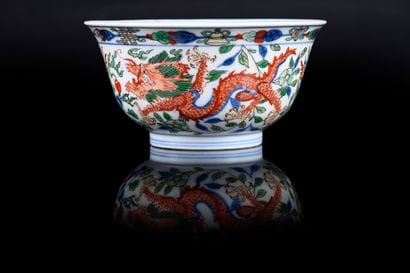
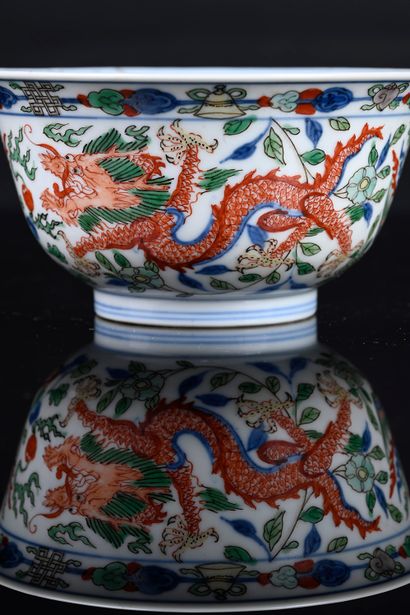
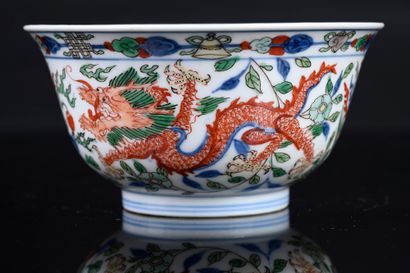
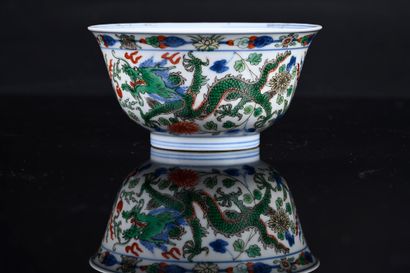
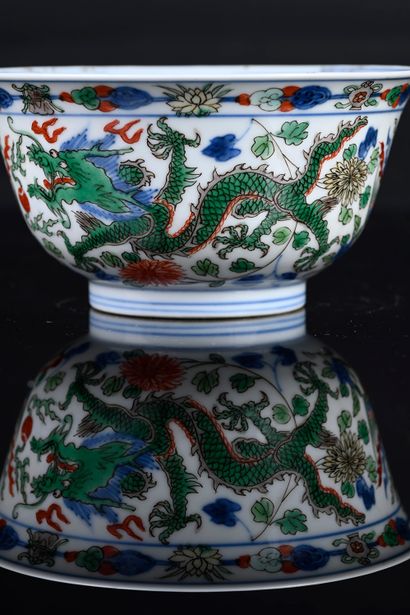
Rare porcelain bowl
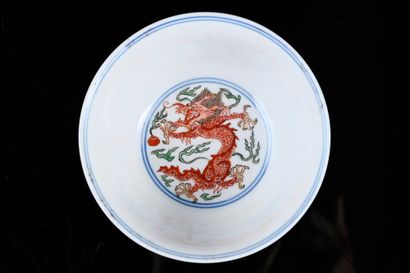
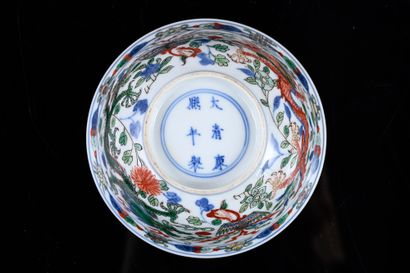
Mounted on a short foot, with a circular wall slightly flared at the opening, decorated in "wucai" enamels (五彩, five colors) with a dragon chasing the sacred pearl in a medallion within the inner wall, the latter delimited by a double blue border, the border also underlined by a double blue border. The outer wall features a rich rotating decoration of dragons and phoenixes moving and chasing the sacred pearl among flowering branches, a frieze decorated with the eight Buddhist emblems below the opening. A six-character Kangxi mark in a double blue frame below.
H. 5.2 cm - D. 10.2 cm
Provenance :
French private collection. Acquired in China around 1890 by a member of the family, a great traveler, then passed on to his daughter, then to his niece and finally to his direct descendant who recently inherited it.
Test:
This "Dragon and Phoenix" porcelain bowl, made in wucai enamels, is part of a decorative repertoire whose genesis dates back to the late Ming period, and whose persistence in the imperial workshops continued through the 18th and part of the 19th centuries. The motif retained its strong symbolic significance, with dragons and phoenixes forming part of the iconography of imperial power and harmony, and was successively reinterpreted under the reigns of the Kangxi (1662-1722) emperors, as attested by our present models, but also Qianlong (1736-1795) and Daoguang (1821-1850), resulting in slight variations in diameter, profile and density of decoration, while maintaining stylistic continuity. The technique of wucai enamels, literally "five colors", combines blue underglaze with polychrome overglaze enamels, producing a characteristic chromatic contrast and a visual reading spread over several levels. During the Qing dynasty, execution became more refined: contours became firmer under Kangxi, then the palette and ornamental distribution became richer under Qianlong and Daoguang, testifying to both technical and aesthetic evolution.
For an example of a Kangxi-marked bowl, see the pair illustrated in "Hong Kong O.C.S., Ch'ing Polychrome Porcelain", 1979, as well as an example published in The Tsui Museum of Art: Chinese Ceramics IV, Qing Dynasty, Hong Kong, 1995, no. 96; see also a pair sold at Christie's on May 28, 2014 in Hong Kong, lot 3317.
My orders
Sale information
Sales conditions
Return to catalogue