


Lot n° 92
Estimation :
2000 - 5000
EUR
Result without fees
Result
: 3 450EUR
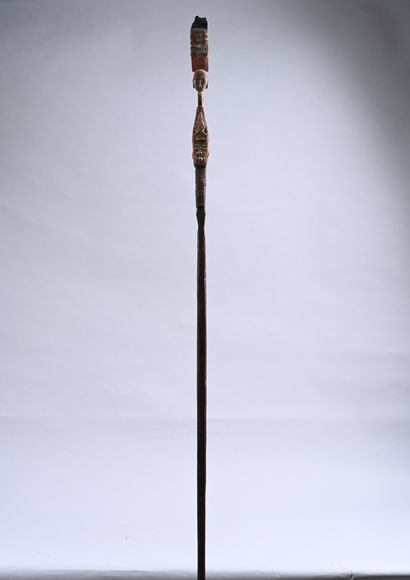
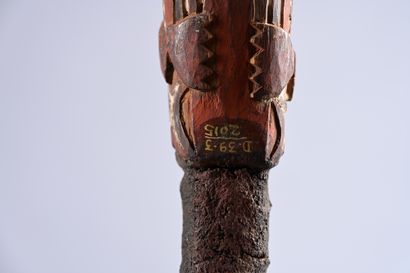
Îles de l'Amirauté ceremonial spear - Lot 92
Îles de l'Amirauté ceremonial spear
Late 19th or early 20th century
Carved wood, pigments, fibers, obsidian tip
Height: 206 cm
Provenance
Collected during the Korrigane expedition (1934-1936)
Inventory number, on deposit at the Musée de l'Homme, Paris: #D39-3-2015
Personal collection of the Van Den Broek d'Obrenan family,
members of the Korrigane expedition
By family descent until the 1990s
Private collection, Paris
Publication:
"Le Voyage de la Korrigane dans les Mers du Sud", Musée de l'Homme, Paris, 2001
---
Ceremonial Lance Admiralty Islands
Late 19th or early 20th century
Carved wood, pigments, fibers, obsidian tip
Height: 206 cm
Provenances:
Collected during the Korrigane expedition (1934-1936)
Inventory number, deposit at the Musée de l'Homme, Paris: #D39-3-2015
Personal collection of the Van Den Broek family from Obrenan,
members of the Korrigane expedition
By family descent until the 1990s
Private collection, Paris
Publication:
"The voyage of the Korrigane in the South Seas", Museum of Man, Paris, 2001
The expedition of La Korrigane stands out as one of the last great ethnographic missions
of the 20th century. Thousands of ethnographic objects were collected, mainly in the
accompanied by photographs and sketches. This collection was presented
for the first time at the Musée de l'Homme, founded by Paul Rivet in 1937.
Broek, one of the main architects of this voyage, took over the Oceania department on his return.
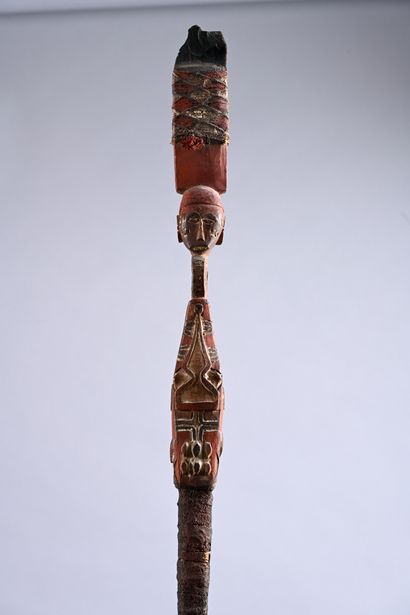
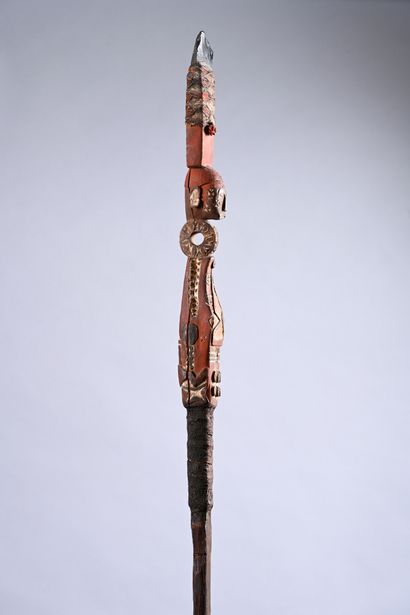
The long shaft of this elegant ceremonial spear is surmounted by a structure combining
zoomorphic and anthropomorphic representations.
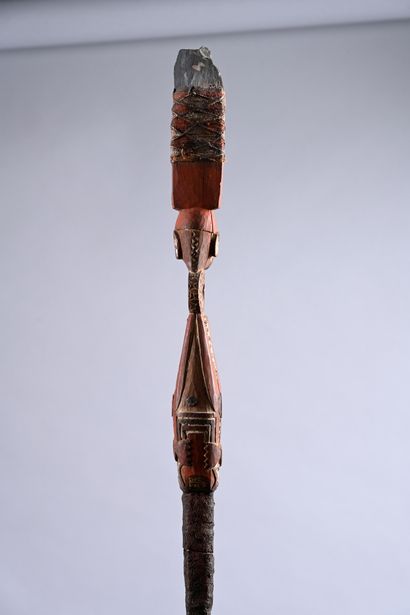
At its center, an openwork ring links a mirrored human face to a crocodile head on either side. This iconographic hybridization has both a symbolic and metaphorical dimension, evoking metamorphoses, totemic figures or mythical ancestors, at the crossroads of the spiritual and terrestrial worlds. The finely-worked human head features almond-shaped eyes surmounted by semi-circular eyebrows
open prognathic mouth carved into the lower part of the face, framed by large circular ears. Opposite it, the crocodile head, a favored totem animal in the iconography of the Admiralty Islands, responds with an equally stylized treatment: a tapering jaw, half-open to rows of pointed teeth, the body covered with red, black and white ornamental motifs evoking scales. The polychromy, superbly preserved, creates a striking contrast with the dark, intense brilliance of the obsidian. The white pigments come from a finely ground lime obtained by calcining seashells, while the red color is obtained from a naturally colored earth.
The island of Lou held an almost exclusive monopoly in the manufacture of objects adorned with obsidian blades.
obsidian blades, making its creations highly sought-after and distinctive. Stéphen Chauvet rightly points out that "obsidian tooling from the Admiralty archipelago is based on a civilization of chipped stone", not polished stone. Here, the armhole, carved from a supple wood, is designed to perfectly fit the heel of the point. The binding is made of finely knotted cord, braided to form beautiful diamond-shaped geometric patterns, while ensuring a solid hold.
---
The Korrigane expedition is one of the last great ethnographic missions of the 20th century. Thousands of ethnographic objects were collected, mainly in Oceanic archipelagos, and accompanied by photographs and sketches. This set was presented for the first time at the Musée de l'Homme, founded by Paul Rivet in 1937, including Charles van den Broek, one of the main artisans of this trip, took on his return the head of the Oceania department.
The long shaft of this elegant ceremonial spear is surmounted by a zoomorphic and anthropomorphic representations. In its center, an openwork ring connects another, mirrored, a human face with a crocodile head. This iconographic hybridization has a symbolic and metaphorical dimension, evoking metamorphoses, figures
totemic or mythical ancestors, at the crossroads of the spiritual and earthly worlds.
The human head, finely worked, presents almond eyes surmounted by brow arches in semi-circle, an open prognóstic mouth sculpted in the lower part of the face, all framed by large circular ears. Facing her, the head of crocodile, totem animal privileged in the iconography of the Admiralty islands, responds to it with an equally stylized treatment: a tapered jaw, half-open on rows of sharp teeth, the body covered with patterns
red, black and white ornaments evoking scales. The polychromy, su
My orders
Sale information
Sales conditions
Return to catalogue