


Lot n° 366
Estimation :
12000 - 15000
EUR
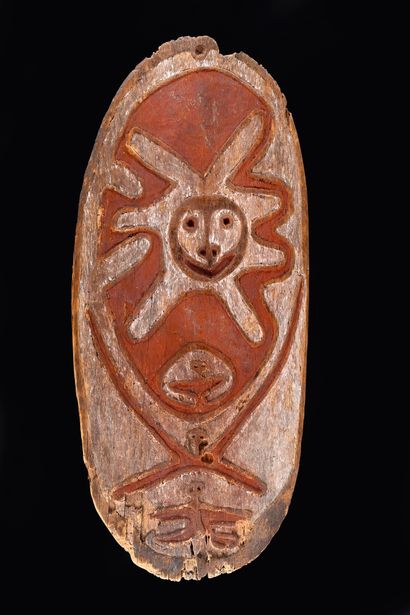
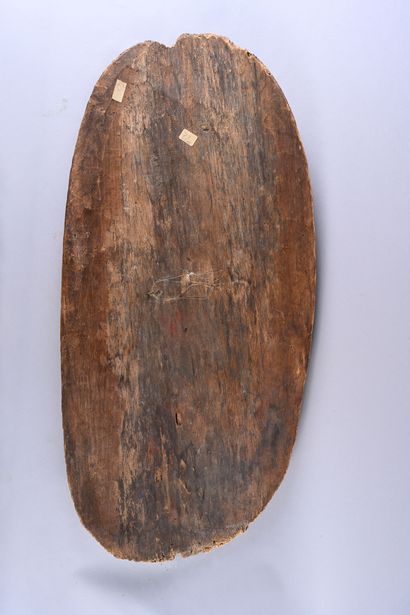
Gope votive board, Omaumere Village, Urama Island, Papua Gul - Lot 366
Gope votive board, Omaumere Village, Urama Island, Papua Gulf, Papua New Guinea
Late 19th-early 20th century
Diomo wood (Pterocarpus indicus), trace of ochre pigment, lime
H. 103 cm
Provenance :
Collected in situ in February 1966 by Thomas Schultze-Westrum
Collection John & Marcia Friede, USA Attached field photograph by Thomas Schultze-Westrum:
Omaumere Village, Urama Island, February 1966, courtesy M. Hamson
Sacred objects artistically materializing ancestral lineages and clans, the votive boards of the Gulf of Papua, called gope by the Urama and
Wapo,temporarily housed the spirit-beings represented (Welsh, Webb and Harara, Coaxing the Spirits to Dance, Art and Society in the Papuan Gulf of New Guinea, 2006, p.42).
In addition to the great rarity of gope plates, the historical nature of this specimen, collected by Thomas Schultze Westrum in February 1966, is evident from his notes.
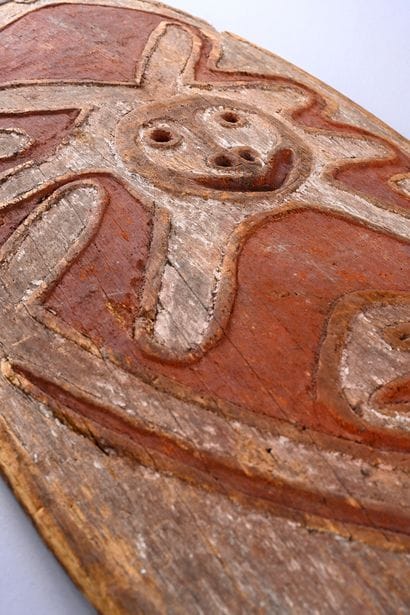
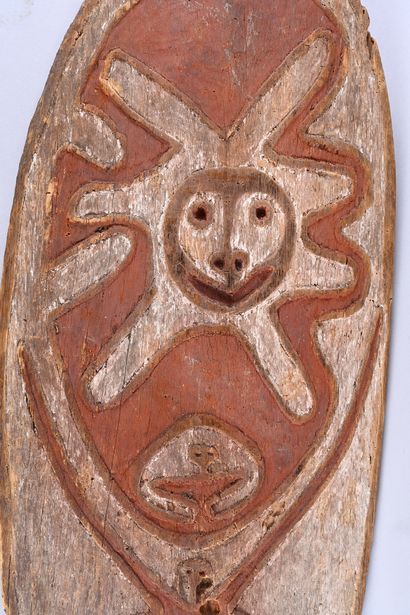
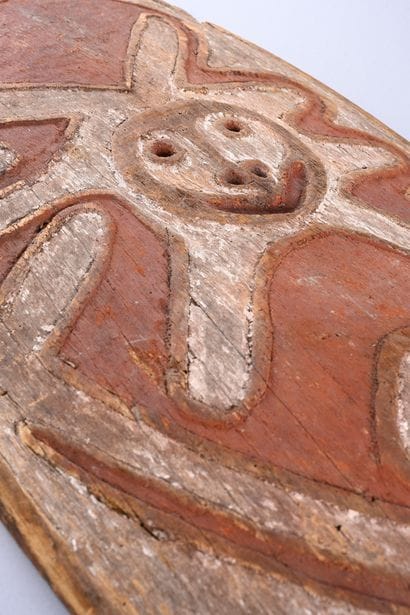
Inscribed in a slender, elongated oval shape, this votive board depicts a stylized male figure, with alternating sculpted reliefs and incised shapes, enhanced by traces of ochre, black and lime pigments, giving its surface a sophisticated, rhythmic graphic rendering.
Its highly distinctive decoration is unmistakably different from the classical corpus. The face is schematized in a rounded form, with a vertical median line suggesting the forehead separating the two small, circular, hollowed-out eyes. Breathing is suggested by two small, round, hollowed nasals. A broad, generous smile follows the shape of the circle around the face. The character's expressiveness is intensified by the singular decorative treatment of the circumference of the face, featuring a superb floral motif.
Frequently used in the ritual art of Papuan societies to mark spiritual growth and rebirth, florality is associated with the idea of the movement of life, renewal and fertility (C.G Seligman, The Melanesians of British New Guinea, Macmillan & Co, 1910).
Its petals, inscribed in a fabulous, poetic dynamic, blossom all over its surface, while the red border clearly demarcating their outline magnifies their form, intensifying the expressiveness of the embracing face and decorated head, probably symbolizing the radiance of the embodied spirit.
The red-pigmented "body", in a repetitive oval shape similar to that of the board, features a tiny figure at its lower end. Below him, a larger figure appears, clearly situated at the very bottom, its disproportionate limbs extending with suppleness and fluidity, certainly suggesting the fertile growth deployed.
Receptacles of powerful spirits, Gope votive boards were kept in the ceremonial house, the seat of the spiritual world, to enable the spirits to communicate with the men of the community. A rare example of ancient art from the Urama district. The remarkable dynamics of the curvilinear, slightly raised decoration, playing subtly with alternating red and white pigments, is accentuated by the slender line of the bark support.
My orders
Sale information
Sales conditions
Return to catalogue