


Lot n° 361
Estimation :
5000 - 8000
EUR
Result with fees
Result
: 6 500EUR
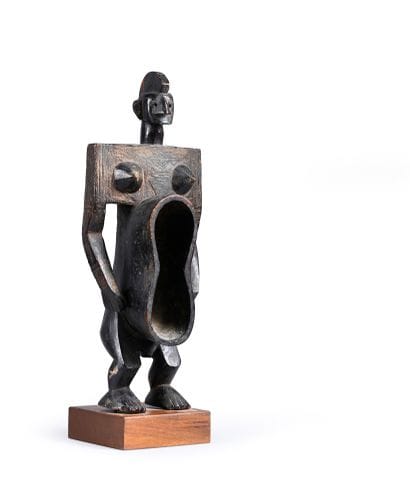
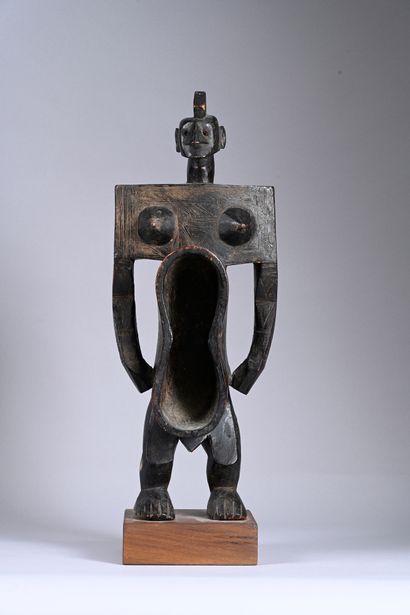
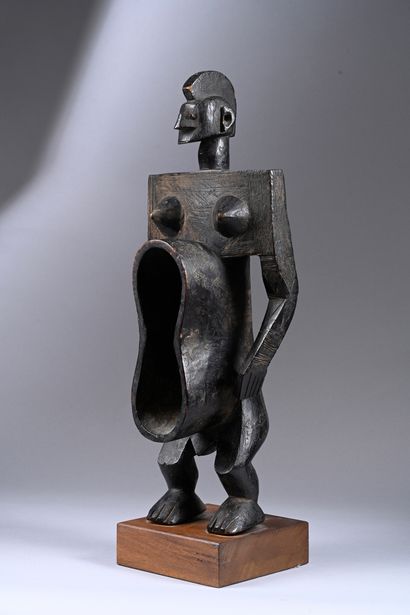
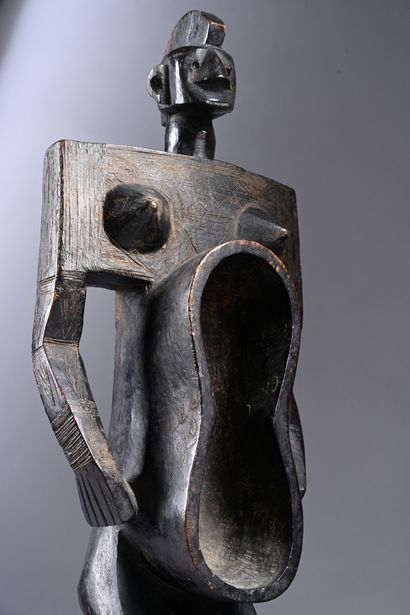
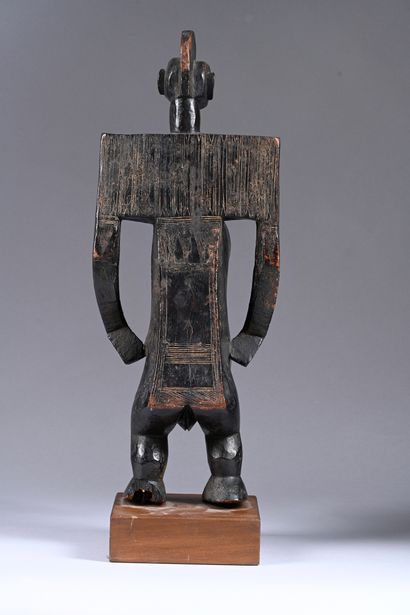
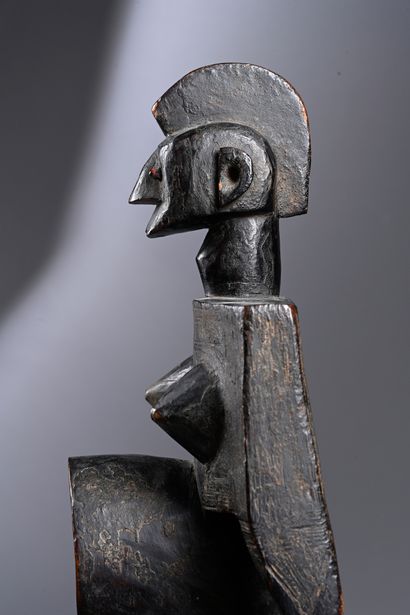
Anthropomorphic bowl, Koro, Nigeria - Lot 361
Anthropomorphic bowl, Koro, Nigeria
19th-20th century
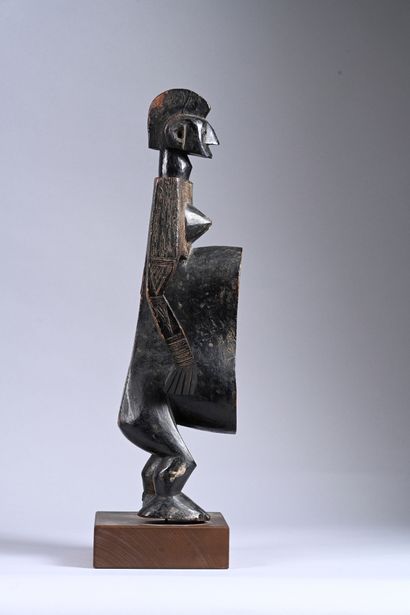
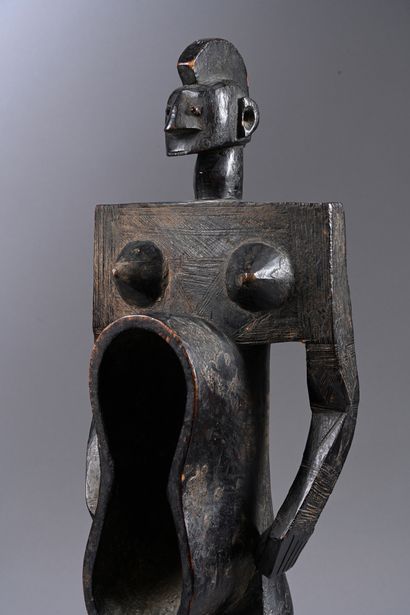
Wood, shiny brown patina in places, scarification marks, traces of unction residue on the inside of the belly in the form of a crusty patina.
H. 49 cm
Provenance :
Bernd Muhlack Collection, Germany, ca. 1969
Michael Muhlack Collection, Germany
Literature :
Schädler, Afrikanische Kunst in deutschen Privat-Sammlungen / African Art in Private
German Collections / L'art africain dans les collections privées allemandes, 1973, p. 243,n°342
The strength of the plastic creativity of these rare statues lies in the bold conception, simplification, reduction and rearrangement of the elements of the body, face and their proportions. The result is an intriguing, captivating figure, with an atypical presence and allure, tending resolutely and unmistakably towards cubist creation, sometimes with almost surrealist aspects.
Part of an extremely small and little-known corpus of African art, this Koro example, attributed to the Gwari people, comes from the region between the Cross River and the middle Benoue.
Its typology, based on tapered legs, allows us, according to the classification of Antonio Casanovas and Ana Gaspar, to attribute it to an archaic style: the so-called "cylindrical style with distinct legs", known as obakuli, of which this work constitutes one of the rare testimonies.
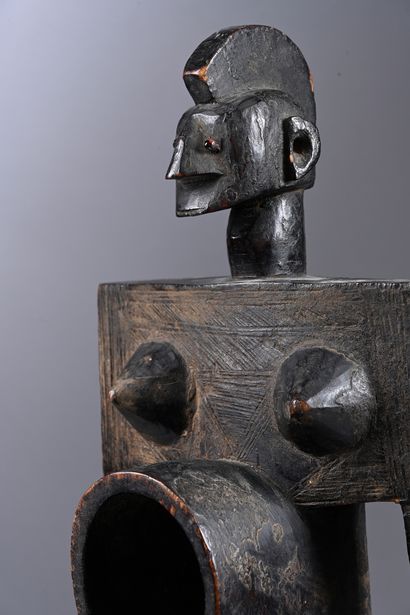
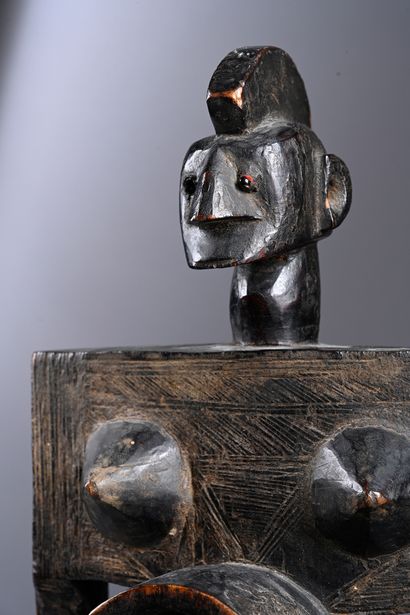
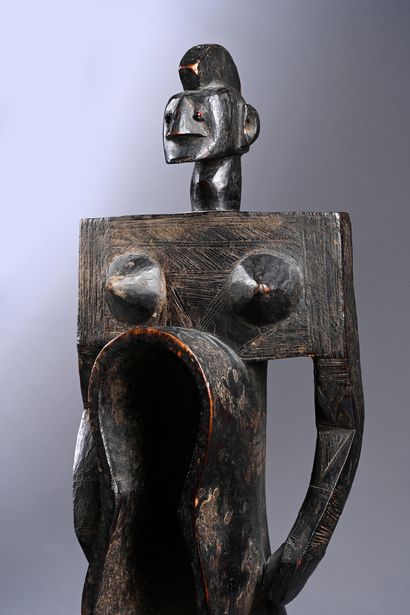
Her imposing stature, rigid, firm, rigorous and proudly planted, is accentuated by the clear angularity of her shoulders and upper torso, embracing a strict rectangular shape, from which springs a powerful, firm, conical chest. Remarkably rigorous minimalist strokes, juxtaposed pure volumes, subtly accentuating points of rupture and planes. The strength of her astonishing presence is contrasted with the delicacy of the engraved geometric decoration.
The angular rigor of the square shoulders is countered by the soft curves of the imposing belly, signified by a curved receptacle. Invading the abdomen, the deeply hollowed receptacle displays a thick, dark, crusty patina, testifying to its past, repeated use. According to Roy Sieber (in RMN, 1997, p. 298), these cups were used during second funeral rites to drink and pour libations of palm wine. Female attributes such as breasts and sex are represented by angular, triangular shapes.
The play of proportions and disproportions reinforces both the boldness of the stylistic conception and the curious, fabulous originality of this work, particularly in the treatment of the small, flattened face with its meticulously sculpted features and sagittal crested hairstyle, comparable to those of their Mumuye neighbors. Its eyes, signified by rounded copper nails, lend the face an eloquent and amusing expressiveness.
Carefully kept out of sight, obakuli received regular offerings to protect their owners, and were only displayed when important guests arrived (Conde Prado, Joyas del Niger y del Benue, 2003, p. 88).
In addition to their prophylactic function, they were remarkably aesthetic. A masterly architectural reinvention of the human figure, surpassing traditional aesthetic canons, taking statuary to a universal dimension.
My orders
Sale information
Sales conditions
Return to catalogue