


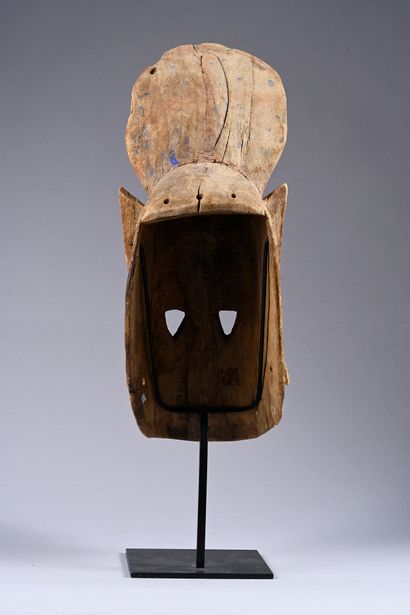
Lot n° 358
Estimation :
2500 - 5000
EUR
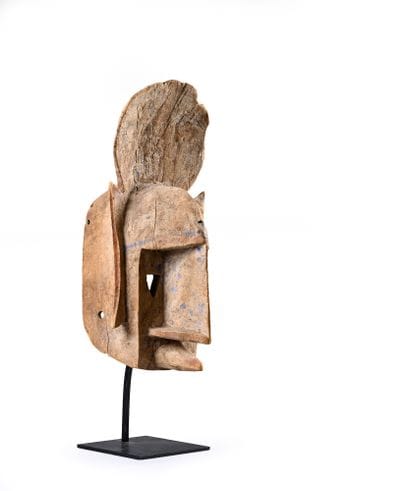
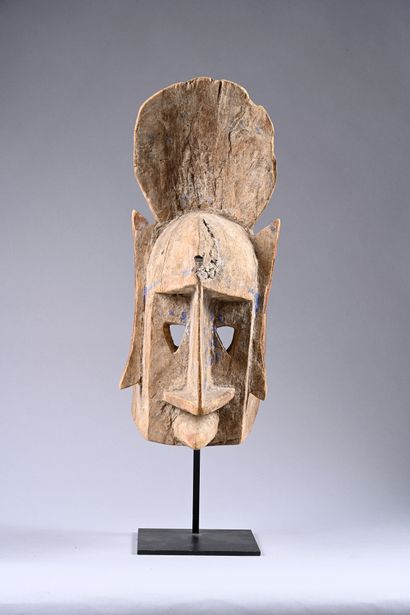
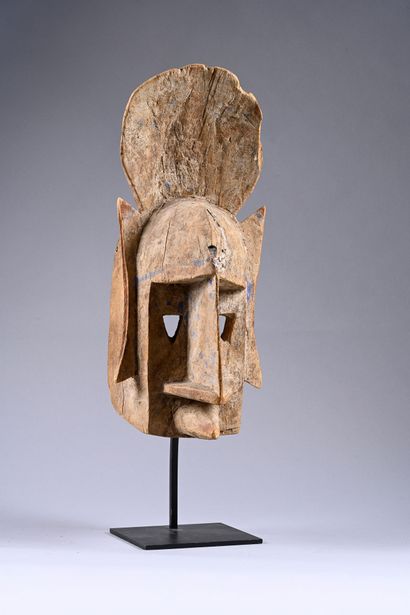
Gomintogo mask, Dogon, Mali - Lot 358
Gomintogo mask, Dogon, Mali
Early 20th century
Carved wood and pigments
H. 41 cm high
Provenance :
Gustau Gili Collection, Barcelona
David Serra Collection, Barcelona
Private collection, Paris
In Dogon belief, at the origin of artistic creation, the concept of Nyama is essential, described as: "a pending energy, impersonal, unconscious, distributed in all men, animals, plants, in supernatural beings, in things, in nature and which tends to make persevere in its being the support to which it is affected temporarily (mortal being) ' or eternally (immortal being) : thus heaven, the dead, genies, altars, manure, trees, seed, stone, beasts, the color red, men have nyama. " (Marcel Griaule, Masques Dogons, 1938, p. 161).
This equally dynamic energy, dependent on the soul (kikinu say) in the case of living beings and apparently independent in the case of inanimate things (Cf. Germaine Dieterlen, Les Âmes des Dogons), is a powerful force that needs to be controlled, calmed and appeased, so that it can cohabit in harmony with the living beings of society.
The nyama of the ancestors, of the deceased, lives and swirls with the living, and this is how the most beautiful artistic creations were born, from this belief in the supernatural immaterial vital force, cohabiting with the living world, they act as intermediaries, relays, generating links, channelling forces to ensure the balance between invisible and living forces. The Nyama is "immediately fixed in another support: altar, mask, amulet" (In Griaule, Dogon masks).
Gomintogo, gomtogo in the singular, is a word found to the west and north-west of the town of Djenné (C.Monteil, Djenné, métropole du delta central du Niger, Paris, 1932, p.3). It designates this type of mask, such as this magnificent example representing a mammal, "a kind of cervid" (P. de Cenival et Th. Monod, description de la Côte d'Afrique, 1506-1507 Valentin Ferandes, publications du Comité d'Études historiques et scientifiques de l'A.O.F, Paris, 1938, p.159).
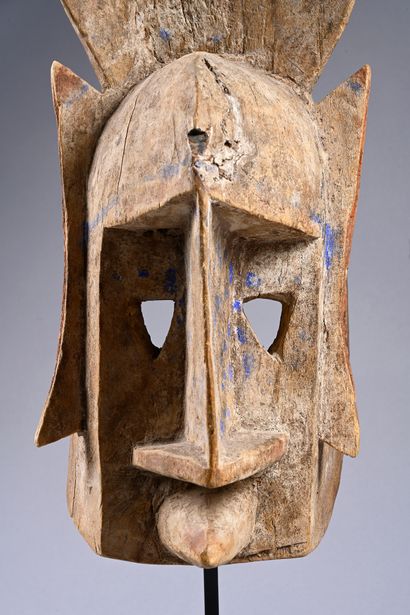
With its flesh-colored webbed antlers, inscribed and shaped in light wood, the mask poetically soars into space through an arrangement of geometric shapes, with the projection of a rounded, flattened headdress curving upwards. The mask features a rectangular face with high-relief features, pierced by two hollowed-out triangular eyes. The facial elements are powerful in their volume and relief. The nose, starting from the rounded forehead and delineated by a prominent nasal bridge, ends in two wide, spatulate wings forming a triangle. Recurrence, resonance and subtle parallelism of repeated forms, with the mouth following the same shape. The long, thin ears are signified by two flat palms with slightly curved, angular upper and lower tips.
Beautiful residues of blue pigments persist on the clear, bleached surface. The mask dance was performed to the rhythm known as albarga: "three strokes of the sticks on the ground, to the right, to the left; crouch, head lowered to the chest." (Marcel Griaule, Masques Dogons, p.421).
Following the advice of the soothsayer, the shape of this type of mask was drawn on the rock face before being carved out of wood. "It was hoped that the gomtogo would follow the soul of the dead man.
My orders
Sale information
Sales conditions
Return to catalogue